RSS

Tag Archives: trends

Digital Trends & Digital Leadership

What are the key digital trends of 2019, and what are the key traits of successful “digital leaders”?

  1. Digital Trends

Research recently released by Harvey Nash/KPMG, Info-Tech, Gartner and Deloitte have highlighted a mostly shared view of of current and future technology focused trends. The research demonstrates that organisations are changing their product/service offerings or business models in a fundamental way, predominantly driven by digital disruption and the need to get closer to the consumer. 

The combined research demonstrated an increased investment in cyber security, data analytics, AI/automation and transformation. Organisations not investing in AI and automation can expect, over time, for their cost base to be relatively higher than their AI-investing competitors.

The combined summarised view of digital trends is shown in the table below:
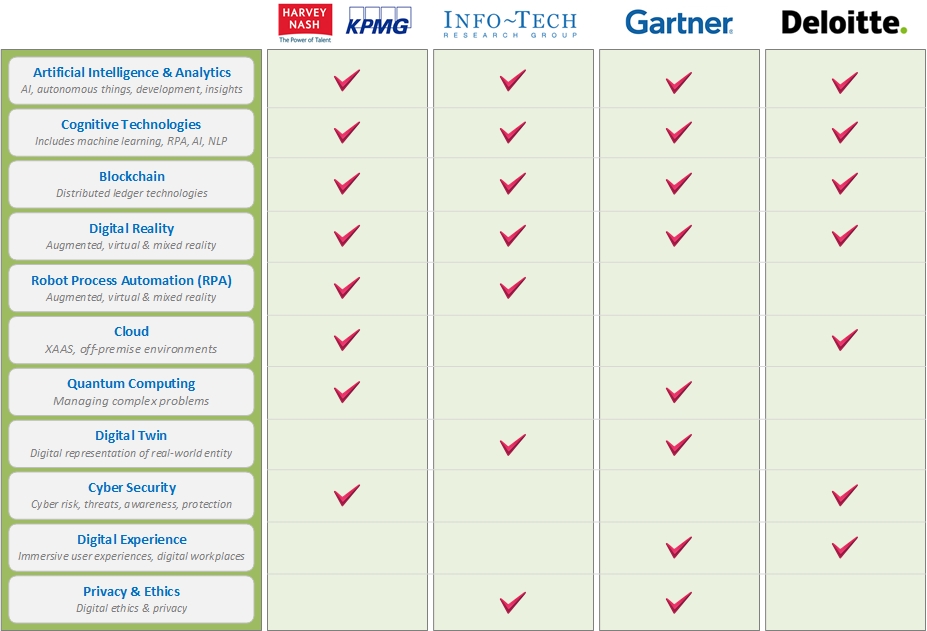
Digital trends where 2 or more trends were featured across the four sources

Digital transformation is becoming business as usual as enterprises look to stay ahead of the game. It has been recognized that digital transformation should and can be handled within existing budgets and without extra investment. 

Digital transformations should be business led rather than IT led, to ensure business leaders are fully engaged with how their operations should be optimized for automation and digital change.

2. Digital Leadership

Leading organisations who demonstrate strong digital leadership experience improved time to market, superior customer experience and high operational efficiency. As a result, both revenue growth and profitability are higher too. Today, there is no longer business strategy and technology strategy. There is just strategy, and technology is driving it.

Digital leaders, as opposed to the Digital Management mainstream, have several traits that set them and their organisations apart from the rest. Digital Leaders distinguish themselves as being more outward-looking, using technology as a means of breaking into new markets, engaging with customers and gaining market share. They also tend to have different operating models that focus on the business owning and leading aspects of technology delivery in collaboration with IT.

Digital leaders:

  • Implement new technologies end-to-end across functions and geographies and change the ways of working to maximise value from technology. They use cross-functional teams (IT and business staff) and ensure business leaders work collaboratively to deliver technology change
  • Report business outcome-based metrics for technology projects, and scale up projects quickly if the project is successful or stop quickly if it isn’t.
  • Integrate core business systems with newer digital solutions and bring a long-term ‘product’ rather than a short-term ‘project’ mindset to technology implementation. They employ automation in software development and maintenance, and use methodologies such as agile and DevOps to speed up project delivery
  • Ensure that non-IT staff have the right technology skills, and use both internal and external resources to access the right skills
  • Maximise value from the data they hold and maintain an enterprise-wide data management strategy
  • Identify and manage the key security and privacy issues across technology development and operations, and build customer trust through the service delivered to customers and end user

In essence, digital leadership is about prioritizing value creation over efficiency generation, with a focus on speed and agility. The role is that of influence and partnering with the business rather than about control.

According to Harvey Nash / KPMG, the top 5 Board Priorities for digital leaders are:

  1. Developing innovative new products and services
  2. Delivering consistent and stable IT performance to the business
  3. Enhancing the customer experience
  4. Improving business processes
  5. Increasing operational efficiencies
 

Tags: , , , , , , , , , , ,

Technology Trends 2015 – The CIO Perspective

Technology Trends 2015 – The CIO Perspective

Early in 2015 Deloittes published their sixth annual Technology Trends report (Tech Trends 2015: The fusion of business and IT).  This publication identifies the eight technology trends that have the most potential business impact over the next 12 to 24 months for technology and business.

Reading through the entire report may not appeal to all audiences, so I have attempted to distil the most relevant take-away points from the perspective of the CIO. What does this actually mean on a day-to-day basis? What aspects of this report deserve serious consideration and action for strategy and planning?


  1. CIO as a Chief Integration Officer

In brief:  The CIO role is evolving, with integration at the core of its mission. CIO’s need to harness emerging disruptive technologies for the business while balancing future needs with today’s operational realities.

Actions:

  • Engage leadership resources to solicit feedback and understand priorities
  • Tap into ideas through new employee and partnership channels
  • Prototype and demo to make the possible become feasible
  • Evaluate the current positioning, and understand the balance sheet of IT
  • Invest in underlying capabilities to improve efficacy


  1. API Economy

In brief:  Application programming interfaces (API’s) are the key to integration, exposing core business assets for reuse, growth, and innovation.

Actions:

  • Have a clear API strategy to define the intention, value and audience of the API.
  • Establish ownership by placing effort under an IT executive to simplify the path forward
  • Evaluate the available tools, platforms and integration possibilities
  • Plan big, start small. Businesses should balance payoff with added complexity
  • See it through. Drive a sustained campaign for awareness and support, while keeping ongoing documentation and maintenance needs in mind.


  1. Ambient Computing

In brief: Harnessing the real potential of the Internet of Things. From the growth of embedded sensors and connected devices, focus on translating the possibilities into real business impact.

Actions:

  • Beware of fragmentation. Use cases will require cross-organisational collaboration
  • Avoid distractions from exciting new technologies by starting with concrete business outcomes.
  • Usability should guide implementation, even if the solution is automated
  • IoT standards are evolving. Don’t wait to invest until the standards are finalised – help shape them.


  1. Dimensional Marketing

In brief:  A new vision for marketing is being formed as CMO’s and CIO’s invest in technology to reach digitally connected customers. CIO’s can help deliver analytics, mobile, social and web.

Actions:

  • Understand the customer journey and focus on authentic engagement
  • Big data and predictive analytics should play a role in how you invest in targets and priorities
  • Have a holistic approach – explore new channels and tools to complement existing ones
  • Authoring, provisioning and measuring usage and effectiveness should be seamless processes that provide users with contextual content across channels
  • Social activation – move beyond passive listening to inspiring brand ambassadors


  1. Software-Defined Everything

In brief: The entire operating environment (server, storage, and network) can now be virtualized and automated.

Actions:

  • Employ standardised design techniques. Emphasise templates and commonality to manage complexity
  • Infrastructure and application teams should work in tandem for rapid deployment
  • Every asset/application should be analysed to determine technical considerations for migration
  • Some vendors may accommodate creative financing arrangements
  • Consider potential benefits in coupling SDDC initiatives with broader IT transformation effort


  1. Core Renaissance

In brief: Use existing investments in core systems to form the foundation for growth and new service development. Modernise systems, re-platform solutions and extend legacy systems to fuel new services & offerings.

Actions:

  • Have a plan – balance business needs with limitations of existing systems and potential of emerging technology
  • Invest deliberately in the core to eventually become a catalyst for growth
  • Partner with strategic venders to explore new solutions for existing issues
  • Embrace a living approach to architecture with usability, integration, data and security in mind
  • Find a burning platform to move the conversation about the core to the centre stage


  1. Amplified Intelligence

In brief: Companies are applying machine learning and predictive modeling to large and complex data sets. Artificial intelligence is now a reality that is not about replacing workers, but augmenting their capabilities. Advanced analytics can help amplify our intelligence for more effective decision making.

Actions:

  • Develop a wish list to guide priorities and reveal what data is needed
  • Balance opportunity against expected organisational resistance.
  • Let user experience dictate the format, granularity and decisiveness of insights
  • Be transparent in intent, and consider programs to re-tool and redeploy workers


  1. IT Worker of the Future

In brief:  Technical talent is scarce, the legacy-skilled workforce is retiring, and skills are needed in the latest emerging, disruptive technologies.  Companies need to cultivate the IT worker of the future, with habits, incentives and skills that are inherently different from those in play today.

Actions:

  • Incentivise IT leaders
  • Rethink hiring. Include externships, hackathons, and recruit those with design aptitude
  • Introduce mechanisms to submit, explore, and develop new ideas
  • Create a virtual culture – provide tools that support remote workers
  • Leverage crowdsourcing, incubators and start-up spaces
  • Invest in your own IT workforce to drive retention and encourage referrals


Exponentials

In brief: Science and technology breakthroughs advancing faster than Moore’s law. Fields include: artificial intelligence; robotics; additive manufacturing; quantum computing; industrial biology; cyber security.

Four dimensions for effective innovation strategy:

  • Trend sensing: stay on top of new developments. Use “show” versus “tell” in demos and prototypes
  • Ecosystems: combine the traditional allies with entrepreneurs, start-ups, venture capitalists, etc
  • Experimentation: fail fast and cheap, move forward, and think about the impact, feasibility and risk
  • Scaling edges: achieve innovation by establishing new teams on the fringes of the organisation
 
Leave a comment

Posted by on May 12, 2015 in general, innovation, strategy


Tags: , , , , , , , , , , , , ,

Mobile Health Applications – Trends and Predictions

The concept of using mobile applications to manage medical conditions and improve health outcomes is well and truly here.

The 4th mHealth App Developer Economics Study (www.mhealtheconomics.com) conducted in Q1 2014, outlines the major trends and direction relating to the mobile health landscape, and confirms the view that mobile health applications will continue to break new ground in terms of innovation, market penetration and change.

The proliferation of smartphones has provided the medium on which mobile health applications are consumed. If we turn the clock back to 2009, only 13% of all handsets shipped were smartphones. Today, smartphones have become the global number 1 connected device (mostly iOS and Android), whilst tablets are now outselling laptops. This means that, apart from some developing regions, almost everyone in the world has (or will have) a device that could run a mobile health solution.

In the Apple and Android app stores there are more than 100,000 apps within the health category. As the study points out, this is more than double the quantity of mobile health apps listed in the store only 2.5 years ago. More than 30% of all apps that are listed in the Health & fitness and Medical app sections are fitness trackers or exercise guides. The second and third largest groups are Medical Reference (16.6%) and Wellness apps (15.5%). Medical reference apps provide information about drugs, diseases, symptoms and give advice on how to take drugs or what to do in case of experiencing pain. They also show locations of pharmacies and medical centres/doctors. Medical condition management apps represent the 5th largest group of mobile health apps (6.6%).

Some of the predictions from the study participants (mobile health app publishers) paint an interesting picture about the future of the mobile health app market:

  • The main market drivers for health apps over the next 5 years are increasing penetration of capable devices and user/patient demand.
  • The potential show-stoppers are lack of data security and standards, and poor discoverability. This could leave room for specialised mobile health app stores.
  • Android and iOS are the dominant mobile platforms for which mobile health app developers will continue developing their apps in the next 5 years.
  • Fitness apps are believed to diminish in their relative importance. In five-years’ time they are expected to go from 1st to 5th position in terms of business potential. The app categories that have the highest expected market potential in the near future are remote monitoring and consultation apps.
  • The areas that are predicted to have the greatest impact on healthcare include improved outcomes of treatments, self-care of people, slowing down the increase of healthcare costs, improved interaction between patients and doctors, and enabling patients to take better care of their own health.

Many of the most popular mobile health apps today draw data/information from different sources to provide an enriched and comprehensive experience to users. This occurs through the use of “APIs”. These API’s are connectors that allow apps to import or export general health information (e.g., databases for drugs, food, diseases), personal health information (e.g., calorie intake, steps, weight), and medical device information (e.g. from glucometers, blood pressure monitors, heart rate monitors, step tracking bracelets).

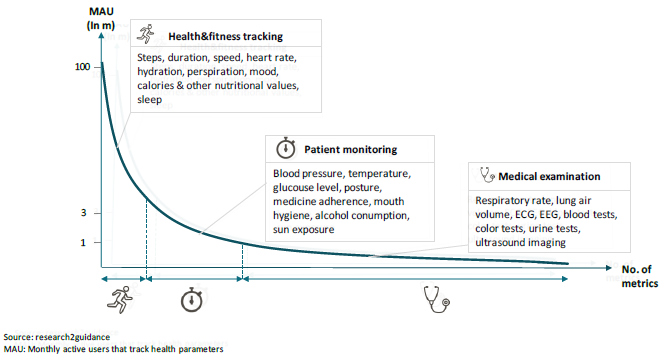
Three different categories of vital parameters are captured today are health & fitness tracking data, patient monitoring data, and medical examination data.

pic

With “consumer directed care” models now part of the health landscape, mobile healthcare apps form part of the solution to empower users/patients to take a more active role in their treatment process. The opportunity is ripe for mobile health to form an integral part of the nation’s healthcare strategy.

In the next 5 years there will be increased prevalence of sensor networks (wearable and built-in sensors). Sensors can have a tremendous impact on the mHealth industry and on how patients track their vital data in the future.

Companies like Apple, Google and Samsung are incorporating more and more sensors into their devices. These companies are seeing the potential in mobile health development, and investing heavily. In May 2014, Reuters reported that Apple has been on a biomedical technology hiring spree. Much of the hiring is in sensor technology, an area Chief Executive Tim Cook singled out last years as primed “to explode”. Recent reports suggest that Apple is developing a smart home platform to enter the Internet of Things space and an iOS application called Healthbook to help users track their heart rate, blood pressure and more. Industry insiders say the moves telegraph a vision of monitoring everything from blood-sugar levels to nutrition, beyond the fitness-oriented devices now on the market. Apple has also poached biomedical engineers from companies including Vital Connect, Masimo Corp, Sano Intelligence and O2 MedTech. Masimo is best known for its pulse oximetry device, which non-invasively measures patients’ oxygen saturation, an indicator of respiratory function. Vital Connect focuses on tracking vitals like heart rate and body temperature. O2 Med Tech also is experimenting with biosensors and developing new devices.

“Internet of Things” and “Big Data” anyone?

 
1 Comment

Posted by on June 2, 2014 in e-health, mobility


Tags: , , , , , , , , , , ,