The concept of using mobile applications to manage medical conditions and improve health outcomes is well and truly here.
The 4th mHealth App Developer Economics Study (www.mhealtheconomics.com) conducted in Q1 2014, outlines the major trends and direction relating to the mobile health landscape, and confirms the view that mobile health applications will continue to break new ground in terms of innovation, market penetration and change.
The proliferation of smartphones has provided the medium on which mobile health applications are consumed. If we turn the clock back to 2009, only 13% of all handsets shipped were smartphones. Today, smartphones have become the global number 1 connected device (mostly iOS and Android), whilst tablets are now outselling laptops. This means that, apart from some developing regions, almost everyone in the world has (or will have) a device that could run a mobile health solution.
In the Apple and Android app stores there are more than 100,000 apps within the health category. As the study points out, this is more than double the quantity of mobile health apps listed in the store only 2.5 years ago. More than 30% of all apps that are listed in the Health & fitness and Medical app sections are fitness trackers or exercise guides. The second and third largest groups are Medical Reference (16.6%) and Wellness apps (15.5%). Medical reference apps provide information about drugs, diseases, symptoms and give advice on how to take drugs or what to do in case of experiencing pain. They also show locations of pharmacies and medical centres/doctors. Medical condition management apps represent the 5th largest group of mobile health apps (6.6%).
Some of the predictions from the study participants (mobile health app publishers) paint an interesting picture about the future of the mobile health app market:
- The main market drivers for health apps over the next 5 years are increasing penetration of capable devices and user/patient demand.
- The potential show-stoppers are lack of data security and standards, and poor discoverability. This could leave room for specialised mobile health app stores.
- Android and iOS are the dominant mobile platforms for which mobile health app developers will continue developing their apps in the next 5 years.
- Fitness apps are believed to diminish in their relative importance. In five-years’ time they are expected to go from 1st to 5th position in terms of business potential. The app categories that have the highest expected market potential in the near future are remote monitoring and consultation apps.
- The areas that are predicted to have the greatest impact on healthcare include improved outcomes of treatments, self-care of people, slowing down the increase of healthcare costs, improved interaction between patients and doctors, and enabling patients to take better care of their own health.
Many of the most popular mobile health apps today draw data/information from different sources to provide an enriched and comprehensive experience to users. This occurs through the use of “APIs”. These API’s are connectors that allow apps to import or export general health information (e.g., databases for drugs, food, diseases), personal health information (e.g., calorie intake, steps, weight), and medical device information (e.g. from glucometers, blood pressure monitors, heart rate monitors, step tracking bracelets).
Three different categories of vital parameters are captured today are health & fitness tracking data, patient monitoring data, and medical examination data.
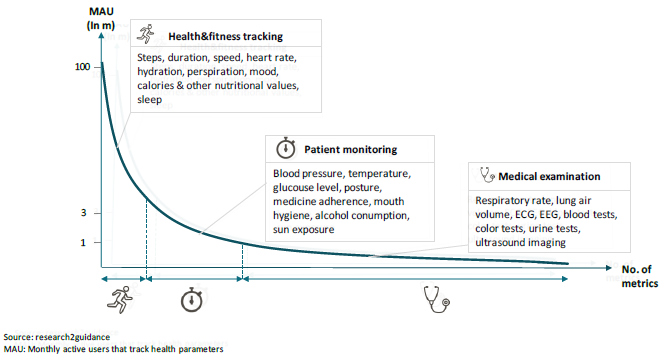
With “consumer directed care” models now part of the health landscape, mobile healthcare apps form part of the solution to empower users/patients to take a more active role in their treatment process. The opportunity is ripe for mobile health to form an integral part of the nation’s healthcare strategy.
In the next 5 years there will be increased prevalence of sensor networks (wearable and built-in sensors). Sensors can have a tremendous impact on the mHealth industry and on how patients track their vital data in the future.
Companies like Apple, Google and Samsung are incorporating more and more sensors into their devices. These companies are seeing the potential in mobile health development, and investing heavily. In May 2014, Reuters reported that Apple has been on a biomedical technology hiring spree. Much of the hiring is in sensor technology, an area Chief Executive Tim Cook singled out last years as primed “to explode”. Recent reports suggest that Apple is developing a smart home platform to enter the Internet of Things space and an iOS application called Healthbook to help users track their heart rate, blood pressure and more. Industry insiders say the moves telegraph a vision of monitoring everything from blood-sugar levels to nutrition, beyond the fitness-oriented devices now on the market. Apple has also poached biomedical engineers from companies including Vital Connect, Masimo Corp, Sano Intelligence and O2 MedTech. Masimo is best known for its pulse oximetry device, which non-invasively measures patients’ oxygen saturation, an indicator of respiratory function. Vital Connect focuses on tracking vitals like heart rate and body temperature. O2 Med Tech also is experimenting with biosensors and developing new devices.
“Internet of Things” and “Big Data” anyone?

 Ben Ward