RSS

Tag Archives: digital

Digital Trends & Digital Leadership

What are the key digital trends of 2019, and what are the key traits of successful “digital leaders”?

  1. Digital Trends

Research recently released by Harvey Nash/KPMG, Info-Tech, Gartner and Deloitte have highlighted a mostly shared view of of current and future technology focused trends. The research demonstrates that organisations are changing their product/service offerings or business models in a fundamental way, predominantly driven by digital disruption and the need to get closer to the consumer. 

The combined research demonstrated an increased investment in cyber security, data analytics, AI/automation and transformation. Organisations not investing in AI and automation can expect, over time, for their cost base to be relatively higher than their AI-investing competitors.

The combined summarised view of digital trends is shown in the table below:
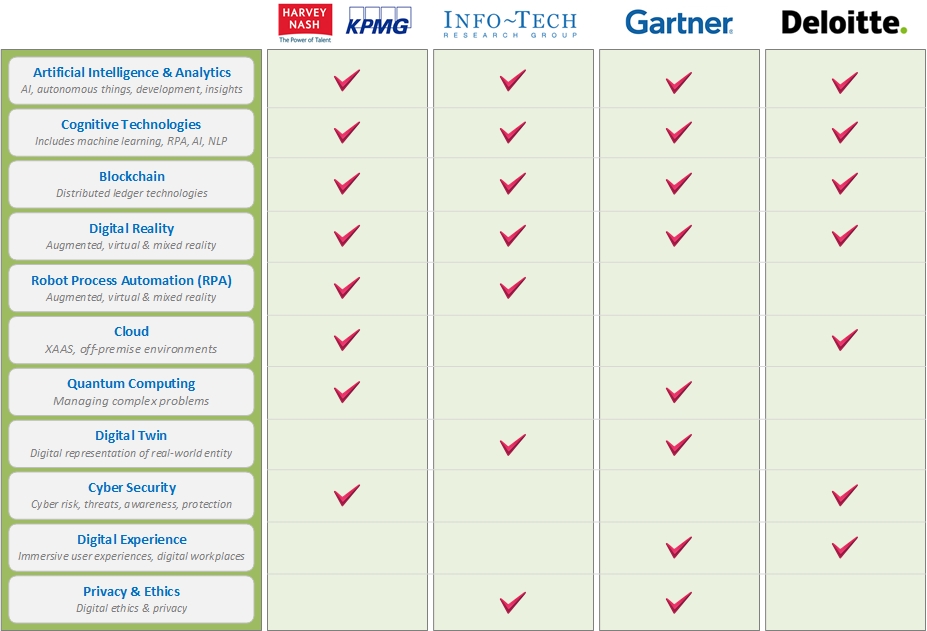
Digital trends where 2 or more trends were featured across the four sources

Digital transformation is becoming business as usual as enterprises look to stay ahead of the game. It has been recognized that digital transformation should and can be handled within existing budgets and without extra investment. 

Digital transformations should be business led rather than IT led, to ensure business leaders are fully engaged with how their operations should be optimized for automation and digital change.

2. Digital Leadership

Leading organisations who demonstrate strong digital leadership experience improved time to market, superior customer experience and high operational efficiency. As a result, both revenue growth and profitability are higher too. Today, there is no longer business strategy and technology strategy. There is just strategy, and technology is driving it.

Digital leaders, as opposed to the Digital Management mainstream, have several traits that set them and their organisations apart from the rest. Digital Leaders distinguish themselves as being more outward-looking, using technology as a means of breaking into new markets, engaging with customers and gaining market share. They also tend to have different operating models that focus on the business owning and leading aspects of technology delivery in collaboration with IT.

Digital leaders:

  • Implement new technologies end-to-end across functions and geographies and change the ways of working to maximise value from technology. They use cross-functional teams (IT and business staff) and ensure business leaders work collaboratively to deliver technology change
  • Report business outcome-based metrics for technology projects, and scale up projects quickly if the project is successful or stop quickly if it isn’t.
  • Integrate core business systems with newer digital solutions and bring a long-term ‘product’ rather than a short-term ‘project’ mindset to technology implementation. They employ automation in software development and maintenance, and use methodologies such as agile and DevOps to speed up project delivery
  • Ensure that non-IT staff have the right technology skills, and use both internal and external resources to access the right skills
  • Maximise value from the data they hold and maintain an enterprise-wide data management strategy
  • Identify and manage the key security and privacy issues across technology development and operations, and build customer trust through the service delivered to customers and end user

In essence, digital leadership is about prioritizing value creation over efficiency generation, with a focus on speed and agility. The role is that of influence and partnering with the business rather than about control.

According to Harvey Nash / KPMG, the top 5 Board Priorities for digital leaders are:

  1. Developing innovative new products and services
  2. Delivering consistent and stable IT performance to the business
  3. Enhancing the customer experience
  4. Improving business processes
  5. Increasing operational efficiencies
 

Tags: , , , , , , , , , , ,

Business Transformation – Turning Digital Thinking into Digital Reality

Business Transformation – Turning Digital Thinking into Digital Reality

The digital revolution is here – it is essential for organisational survival, and is now a natural expectation of staff, customers, managers, boards and industry partners.   Failure to embrace digital disruption will ultimately result in significant impacts to organisational efficiencies (at best), or will ultimately lead to organisational demise (at worst).

Organisations are using technologies like social media, mobile, analytics and embedded devices to change their customer engagement, internal operations and even their business models. Whilst there are many organisations that are realising real benefits, many organisations are left wondering how to start the journey, or how to successfully execute a digital transformation.

Based on various studies, research and personal experience, the following key practices are critical in enabling organisations to undertake successful digital transformation:


1.  Develop a Vision

Senior leaders need to have a common vision of how to proceed, and weed out the activities that run counter to that vision. They also need to understand why to change, and how the future will be better than the current situation. Without a vision of change, employees tend to do what they have been doing for years, even if it is no longer useful in the digital world. The first step is to understand the threats and opportunities that digital represents to the organisation. Will existing ways of working continue to be effective in a digital world? Are there new opportunities available in customer experience, operational processes or business models? It is also important to assess the organisations digital maturity.

Organisations must change the approach from supporting the business with information technology, to identifying what is possible with digital – starting with mobility, cloud, situational context, and then consider how to get there from here using technology as the catalyst.

2.  Invest in Digital

To realise the digital vision, organisations must invest in the right areas. This includes cutting back in unproductive areas while ramping up investment where it needs to occur. Organisations should choose to excel in a few areas based on existing capabilities such as customer experience, social media, mobile, customer analytics, process digitization or internal collaboration – but not in all.

Organisations will need to consider adapting their business model, which could include adding value to products and services, reaching new customers, linking operational and customer-facing processes in new ways, and even launching entirely new businesses. Strong governance mechanisms are also required to increase the level of coordination and sharing across silo-run digital initiatives.

3.  Organisational Engagement

When employees are engaged in a shared vision they help to make the vision a reality. They offer less resistance to change and often identify new opportunities that were not previously envisioned. It is beneficial to use a wide array of digital channels, such as broadcast, web, video, and social networks to generate continuous two-way communication at scale. Equally important is to encourage employees to identify new practices and opportunities that will advance the vision.

4.  Customer Focus

From a digital solution perspective, focus on user experience design by directly engaging with your customer base. Ask for feedback, challenge current processes, and validate effectiveness. Provision of products or services can be enhanced by engagement with the customer base to understand the demand, and include co-design, enabling greater take-up and the ability for self-service. Provide access to your products and services from anywhere, anytime and on any device, regardless of location.

5.  Cloud First

Investment in cloud based platforms can accelerate the journey to digital, providing opportunities for simplified mobile platform interfaces, use of contextually aware services (utilising customer location, preferences, usage history, etc), context sensitive data integration and data exchange among mobile, big data analytics, social media, internet of things, etc. Develop capabilities to generate forward-looking predictive analytics and overlay with open data sources to truly innovate and provide value.

6.  Sustain the Transformation

Successful digital transformation is built on a foundation of core skills and capabilities. Assess the skills on your teams to insure they fit the new platforms for digital business. Consider hiring some experienced executives who can make an impact quickly and coach existing employees. Redesign your training programs to develop skills your company needs. Where useful, partner with vendors to gain skills and cross-sector experience that complements your capabilities. Senior leaders must focus on building and sustaining momentum for change.

Quantify and monitor progress toward the digital ambition through KPIs or digital scorecards. Scorecards have power beyond just measuring the impact of major investments. They help to change the culture. A shared understanding between IT and business executives is also critical to success.


For a real-world case study (from independent research firm Gartner), please see the link below or contact me via email, linkedin, twitter or this post.

Building a Digital House: How an Industry Regulator Created an Exemplary Public-Sector Digital Service Model


Tags: , , , , ,

eHealth in 2015 – what’s in store?

eHealth in 2015 – what’s in store?

2015 is set to be a progressive year for eHealth.  Following the momentum built up in 2014, I take a look at the top 4 predictions and eHealth “hot-spots” that deserve the attention of Healthcare strategists in 2015.


Personally Controlled Electronic Healthcare Record (PCEHR)

In 2015 expect to see substantial progress in the PCEHR and integration of clinical information. Some of the progress made in 2014 will flow on to impact providers and consumers of Healthcare in 2015. Healthcare providers in particular should already have plans in place to align with the work NEHTA is doing, and if not, get prepared now for change.

The National E-Health Transition Authority (NEHTA) will offer funding to private hospital groups to begin integrating their systems with the PCEHR. They have released the details of their Private Hospital PCEHR Rapid Implementation Program (RIP), which will contribute towards the technical requirements for uploading and viewing of clinical documents. Release five of the PCEHR will pave the way for NEHTA to work with pathology and diagnostic imaging services to enable provider information systems to send PDF pathology and diagnostic imaging report to the PCEHR.

In Aged Care, 2015 will (hopefully) see the formation of a single client record that aligns the Aged Care Gateway system and the central client record, to the PCEHR.

In Melbourne, Western Health is gearing up to enter phase two of a project to securely deliver notifications from its hospital systems directly into GP desktop practice management software through an SMD-compliant eMessaging Gateway.  This initiative, and others like it, will become more common-place in 2015.


Expanding Consumer Choice

Consumer Directed Care (CDC) is set to be more widely integrated in 2015, with a broadening of services offered under this model.  Whilst CDC within the home and community care setting will continue to develop strengthen, residential aged care looks to embrace the same model of handing control to consumers over their choice of providers.

The My Aged Care gateway website for example, could be the “virtual marketplace where consumers and providers – or demand and supply – meet”.   The quote from a speech delivered by Senator Mitch Fifield goes on to say “Trip Advisor style capacities on the My Aged Care website will develop ratings for the quality of providers and their services, according to what matters to consumers, rather than what Departments and providers think they should be”.

CDC for Residential Aged Care is good for consumers, and is currently in the mindset of policy makers.  Residential Aged Care providers would be wise to consider the impacts of this, and think about strategies to best position themselves for the years ahead.

A current challenge is how Healthcare Providers will manage the new CDC reporting requirements. From July 2015 all Home Care Packages will be delivered on a CDC basis, so there is some concern in the industry around the lack of IT capability to deliver on these reporting requirements as July 2015 approaches.


Digital Healthcare

In 2015 many facets of healthcare will increasingly be digitised. Healthcare digitisation offers many benefits around clinical workflow automation, storage savings, longevity of records, and transmission and communication of clinical information.

Fully digital hospitals promise connection, integration and digitisation of medical records, x-rays, pathology results, radiology imaging, medications, CT/MRI scans, vital signs and other health information. Digitisation also provides opportunities around big data analytics and business intelligence to gain a broader picture of patients to improve health outcomes.

Other examples of digital healthcare include: doctors using speech recognition software to translate voice instructions directly onto patient records; linking patient meal planning with allergies and conditions (eg diabetes); medication verification and stock supply; and fingerprint biometrics for clinical staff access to rooms and systems.

It is not just hospitals that will benefit from digital healthcare in 2015. In the home care space a clinically validated monitor has recently been released that allows home users to measure blood pressure and heart rate, and connect it wirelessly to a mobile app. QardioArm works with Apple’s HealthKit, which lets users access all their health and wellness information in one place. It also records irregular heart beat history to provide a reference for doctors. This is just one of many examples.

With digitisation of healthcare inevitably on the rise, appropriate management and governance within this new paradigm will be required.  One example that helps pave the way is the release of the “Clinical Images and the Use of Personal Mobile Devices” guide, which was created to assist doctors and medical students in the proper use of personal devices such as smartphones, when taking and transmitting clinical images.


Interoperability

Interoperability is essentially an expansion of the PCEHR.

In the medication management space, 2015 may be the year to directly import medication information out of the PCEHR or GP systems straight into Healthcare Providers medication management (or clinical) system.   From a hospital perspective, work needs to be done to address the challenges faced by interoperability between different clinical systems, as well as the challenges in mapping the Australian Medicines Terminology (AMT) to SNOMED CT-AU.

2015 will also see the continued proliferation of wearable devices. A recent survey from Kronos indicates that 30 per cent of Australians use wearable devices in their personal lives. This adoption rate could result in a smooth transition to wearables for health and fitness use. Health and fitness data can be useful in doctor consultations to aid diagnostics, and in the future could be designed as medical devices and for monitoring general health and well-being.   There will be a time where the patient will upload the data and it will end up on the health professional’s screen.  It may not happen in 2015, but it will happen.

Some wearable devices that already exist include glucose meters that allow clinic alerts and remote monitoring; devices that monitor vital signs; devices and apps that allow patients to monitor their diets; and apps to help with medication compliance. Check out my blog “The Mobile eHealth Revolution” for more information.

 
Leave a comment

Posted by on December 8, 2014 in e-health, strategy


Tags: , , , , , , , , , , , , , , , , , , , , , , , , , , ,