RSS

Tag Archives: cloud-computing

Digital Trends & Digital Leadership

What are the key digital trends of 2019, and what are the key traits of successful “digital leaders”?

  1. Digital Trends

Research recently released by Harvey Nash/KPMG, Info-Tech, Gartner and Deloitte have highlighted a mostly shared view of of current and future technology focused trends. The research demonstrates that organisations are changing their product/service offerings or business models in a fundamental way, predominantly driven by digital disruption and the need to get closer to the consumer. 

The combined research demonstrated an increased investment in cyber security, data analytics, AI/automation and transformation. Organisations not investing in AI and automation can expect, over time, for their cost base to be relatively higher than their AI-investing competitors.

The combined summarised view of digital trends is shown in the table below:
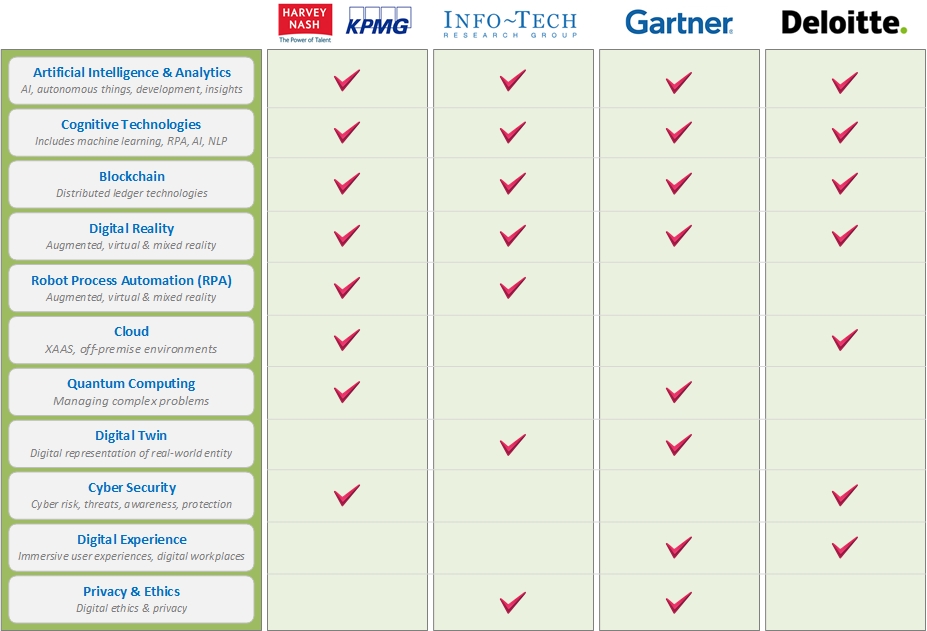
Digital trends where 2 or more trends were featured across the four sources

Digital transformation is becoming business as usual as enterprises look to stay ahead of the game. It has been recognized that digital transformation should and can be handled within existing budgets and without extra investment. 

Digital transformations should be business led rather than IT led, to ensure business leaders are fully engaged with how their operations should be optimized for automation and digital change.

2. Digital Leadership

Leading organisations who demonstrate strong digital leadership experience improved time to market, superior customer experience and high operational efficiency. As a result, both revenue growth and profitability are higher too. Today, there is no longer business strategy and technology strategy. There is just strategy, and technology is driving it.

Digital leaders, as opposed to the Digital Management mainstream, have several traits that set them and their organisations apart from the rest. Digital Leaders distinguish themselves as being more outward-looking, using technology as a means of breaking into new markets, engaging with customers and gaining market share. They also tend to have different operating models that focus on the business owning and leading aspects of technology delivery in collaboration with IT.

Digital leaders:

  • Implement new technologies end-to-end across functions and geographies and change the ways of working to maximise value from technology. They use cross-functional teams (IT and business staff) and ensure business leaders work collaboratively to deliver technology change
  • Report business outcome-based metrics for technology projects, and scale up projects quickly if the project is successful or stop quickly if it isn’t.
  • Integrate core business systems with newer digital solutions and bring a long-term ‘product’ rather than a short-term ‘project’ mindset to technology implementation. They employ automation in software development and maintenance, and use methodologies such as agile and DevOps to speed up project delivery
  • Ensure that non-IT staff have the right technology skills, and use both internal and external resources to access the right skills
  • Maximise value from the data they hold and maintain an enterprise-wide data management strategy
  • Identify and manage the key security and privacy issues across technology development and operations, and build customer trust through the service delivered to customers and end user

In essence, digital leadership is about prioritizing value creation over efficiency generation, with a focus on speed and agility. The role is that of influence and partnering with the business rather than about control.

According to Harvey Nash / KPMG, the top 5 Board Priorities for digital leaders are:

  1. Developing innovative new products and services
  2. Delivering consistent and stable IT performance to the business
  3. Enhancing the customer experience
  4. Improving business processes
  5. Increasing operational efficiencies
 

Tags: , , , , , , , , , , ,

e-Health and Mobility – Strategy in a Nutshell

There are some staggering statistics recently released by Forbes regarding smartphones and apps. According to Forbes (www.forbes.com) there will be 1 billion smartphones sold in 2013, which is twice the number of PC’s predicted to be sold that year.  By 2016 there will be 10 billion mobile internet devices used globally, which is 50 times the size it is today.  Between 2010 and 2011 the time spent on mobile apps began to outpace the time spent on the desktop or mobile Web.  In the same time period there was a 91% increase in the time users spent on mobile applications. By 2015, mobile application development projects targeting smartphones and tablets will out-number native PC projects by a ratio of 4-1. Between 2009 and 2014 the market for cloud-based mobile apps is projected to increase by nearly 90%.

So what does all this mean ???

The mobile revolution is well and truly here. Organisations of all sizes need to have developed a solid and robust mobile strategy, or face being left behind by clients and competitors.  Whilst there is still some contention over the best strategic approach to mobile application development, there is no doubt that mobile applications are front and centre in leveraging market opportunities, client engagement, process efficiencies, and strategic innovation.

In a recent blog post I proposed the inclusion of a Mobile Enterprise Application Platform (or MEAP) as an integral part of any mobile strategy. Of course, this particular strategy depends on the nature of the organisation and its key mobility objectives; however MEAP should not be overlooked when considering a long term view to deployment of multiple different mobile applications, using multiple back-end systems, across any device.

For medium to large sized healthcare organisations, a MEAP based mobile strategy has several advantages over a natively developed application, which is often built with a pre-defined range of objectives, or based on one back-end system.  In this scenario, a mobile platform approach is superior because it:

–          Enables the organisation to customise a solution into fit exact requirements, tailored to the business needs and processes

–          Can provide a competitive advantage, as no one else has that particular mobile application

–          Ensures that changes to the mobile solution are immediate, flexible and more cost effective

–          Is not restricted by the type of mobile device. Mobile platform applications built using HTML5 ensure availability on any mobile device

–          Aligns to organisational “bring your own device” policies (if applicable)

–          Ensures that any development code (apps or API’s) can be re-used to help build other apps

–          Fits into the organisations long term strategies and e-health vision to provide mobile solutions for other uses, for example

      • Bedside medication management
      • Bedside electronic progress notes and electronic care planning
      • Capturing of client and staff incidents, risks, compliance and improvement initiatives
      • Mobile business intelligence and analytics
      • Mobile clinical assessments
      • Information management (eg, mobile access to policies or corporate documents)
      • Others ???

The above examples are likely to need data integrated from multiple in-house systems, which plays into the hands of a mobile platform. While organisations may not require mobility solutions for all the above examples right now, establishing a mobile platform caters for immediate AND long-term organisational use of mobility, even if the future state is not known.  The mobility platform approach has already harnessed recognition across all the major ICT industry research groups including Gartner and Forrester, and is a key component of the ICT Strategy toolkit.

 
4 Comments

Posted by on November 30, 2012 in e-health, mobility


Tags: , , , , , , , , , , , , ,

Does your Mobile Strategy have MEAP ?

Significant growth is forecast in the use of Smartphones worldwide. With this growth in Smartphone use comes an increase in the consumption of mobile applications.

Many businesses have already jumped (or are in the process of jumping) onto the mobile development bandwagon to take advantage of the opportunities and innovation that mobile applications can deliver. Take Dominos Pizza for example. Dominos embraced mobile as a way to enable customers to place orders, and now has more than 30% of their orders placed online or from their smartphone app.

Failure to have a well-considered mobile strategy could make or break business, so it’s important to get it right. One consideration that is gaining momentum at the moment is Mobile Platform as a Service – or a “Mobile Enterprise Application Platform” (MEAP). The MEAP term was originally coined by Gartner, and is a serious alternative to developing bespoke mobile apps. MEAP’s offer fast development, and can be delivered across multiple platforms without the need to re-engineer code. In other words, companies can use a MEAP to develop the mobile application once and deploy it to a variety of mobile devices (including various smart phones, tablets, notebooks, handhelds etc) with no changes to the underlying business logic. This makes it easy to align with your BYOD strategy. MEAP’s can be made available in online and offline mode, and are great for organisations who wish to deploy multiple applications on a single infrastructure.

So, who should consider MEAP as part of their mobile strategy ?

Gartner developed a concept called “the rule of three”, where they encourage companies to consider the MEAP approach to mobility when they need their mobile solutions to:

  • Support three or more mobile business applications
  • Support three or more mobile operating systems (OS)
  • Integrate with at least three back-end data sources

I am currently in the process of sourcing trusted Australian based MEAP providers. If you know of any, I would greatly appreciate if you could get in touch.

 
2 Comments

Posted by on July 30, 2012 in mobility


Tags: , , , ,