RSS

Tag Archives: augmented reality

Digital Trends & Digital Leadership

What are the key digital trends of 2019, and what are the key traits of successful “digital leaders”?

  1. Digital Trends

Research recently released by Harvey Nash/KPMG, Info-Tech, Gartner and Deloitte have highlighted a mostly shared view of of current and future technology focused trends. The research demonstrates that organisations are changing their product/service offerings or business models in a fundamental way, predominantly driven by digital disruption and the need to get closer to the consumer. 

The combined research demonstrated an increased investment in cyber security, data analytics, AI/automation and transformation. Organisations not investing in AI and automation can expect, over time, for their cost base to be relatively higher than their AI-investing competitors.

The combined summarised view of digital trends is shown in the table below:
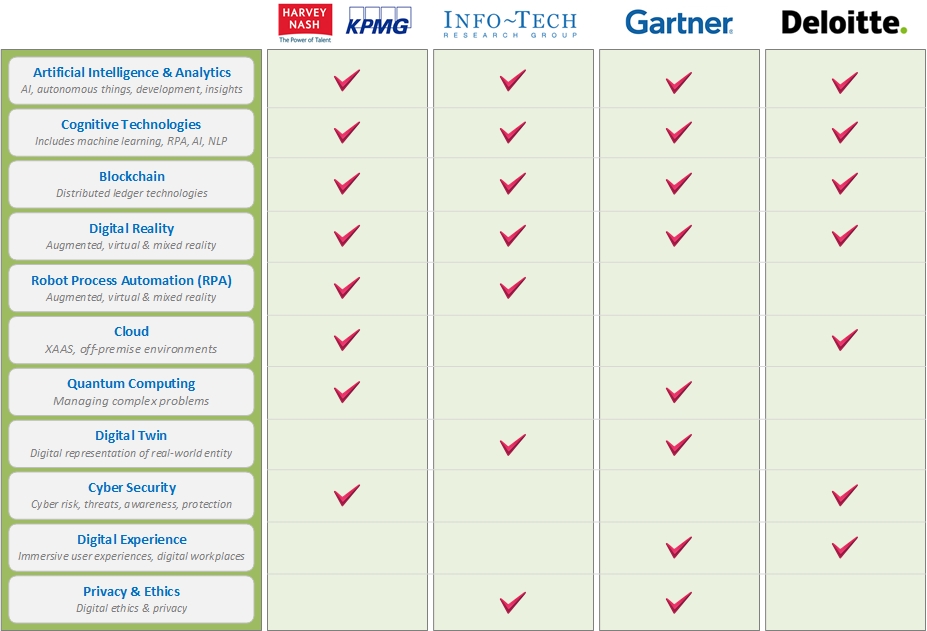
Digital trends where 2 or more trends were featured across the four sources

Digital transformation is becoming business as usual as enterprises look to stay ahead of the game. It has been recognized that digital transformation should and can be handled within existing budgets and without extra investment. 

Digital transformations should be business led rather than IT led, to ensure business leaders are fully engaged with how their operations should be optimized for automation and digital change.

2. Digital Leadership

Leading organisations who demonstrate strong digital leadership experience improved time to market, superior customer experience and high operational efficiency. As a result, both revenue growth and profitability are higher too. Today, there is no longer business strategy and technology strategy. There is just strategy, and technology is driving it.

Digital leaders, as opposed to the Digital Management mainstream, have several traits that set them and their organisations apart from the rest. Digital Leaders distinguish themselves as being more outward-looking, using technology as a means of breaking into new markets, engaging with customers and gaining market share. They also tend to have different operating models that focus on the business owning and leading aspects of technology delivery in collaboration with IT.

Digital leaders:

  • Implement new technologies end-to-end across functions and geographies and change the ways of working to maximise value from technology. They use cross-functional teams (IT and business staff) and ensure business leaders work collaboratively to deliver technology change
  • Report business outcome-based metrics for technology projects, and scale up projects quickly if the project is successful or stop quickly if it isn’t.
  • Integrate core business systems with newer digital solutions and bring a long-term ‘product’ rather than a short-term ‘project’ mindset to technology implementation. They employ automation in software development and maintenance, and use methodologies such as agile and DevOps to speed up project delivery
  • Ensure that non-IT staff have the right technology skills, and use both internal and external resources to access the right skills
  • Maximise value from the data they hold and maintain an enterprise-wide data management strategy
  • Identify and manage the key security and privacy issues across technology development and operations, and build customer trust through the service delivered to customers and end user

In essence, digital leadership is about prioritizing value creation over efficiency generation, with a focus on speed and agility. The role is that of influence and partnering with the business rather than about control.

According to Harvey Nash / KPMG, the top 5 Board Priorities for digital leaders are:

  1. Developing innovative new products and services
  2. Delivering consistent and stable IT performance to the business
  3. Enhancing the customer experience
  4. Improving business processes
  5. Increasing operational efficiencies
 

Tags: , , , , , , , , , , ,

2017 Strategy Considerations

2017 Strategy Considerations


This post explores some key innovations and technologies that are worthy of consideration for strategy planning in 2017 and beyond. Whilst each of the technology innovations are at different stages of maturity, hype and utilisation in the market, each should be considered for their potential uses and applicability as part of blue-sky innovation and strategic planning processes.


Artificial Intelligence and Machine Learning

Artificial Intelligence and machine learning include systems that appear to learn, understand, predict and operate with minimal (or no) human guidance. These characteristics make machines appear intelligent. Smart machines intelligent applications can change their future behaviour through learning. Real world examples include robots, autonomous vehicles, drones and virtual personal assistants, intelligent sensors, smart appliances and smart tools (such as a digital stethoscope).


The New “Realities” – Virtual and Augmented

Virtual reality (VR) is essentially technology that generates a virtual environment, and simulates a user’s physical presence in this environment through interaction. The virtual environment is separate from the real-world environment, and headwear is typically used to shut-out the immediate surroundings from the virtual world. In a work environment VR can be very beneficial for training, where staff can develop skills in the virtual world without the real-world consequences of failing.

Augmented reality (AR) overlays virtual objects with the environment around you. Unlike virtual reality, which creates a totally artificial environment, augmented reality uses the existing environment and overlays new information on top of it. The most well-known real-world example is Pokomon Go. Other examples include the Topshop AR dressing rooms which allows shoppers to virtually try on new clothes. There is also the Shisedio makeup mirror, the IKEA AR catalogue (to visualise how various furniture would look inside your home) and the IBM shopping app, which provides personalised information whilst browsing the shelves.


Mobile Wallet

The use of mobile wallets is continuing to go mainstream, and fully integrated mobile wallets are starting to become a reality. Mobile wallets store payment credentials to enable users to authenticate themselves and/or make transactions from a mobile device. The credentials can be payment-related, such as a bank card, bank account or prepaid card, or non-payment-related, such as a loyalty card or mileage card. There are also closed wallets that allow use at specific merchants and open wallets that allow use at many other merchants. Businesses, retailers and organisations need to embrace this change, and identify the opportunities and risks of the technology.


Natural Language Question Answering

Natural-language question answering (NLQA) technology is a type of natural-language processing technology, composed of applications that provide users with a means of asking a question in plain language. A computer or service can answer it meaningfully, while maintaining the flow of interaction.

Unlike information retrieval systems such as search engines, NLQA aims to supply users with “just the right information” instead of merely providing a list of hits. NLQA technology is improving at a rapid pace. Current day examples include SIRI, Cortana and GoogleNow, however they are more like voice assistants and text analysers than true NLQA systems. Future uses in business include the use of NLQA in answering customer queries, contact centre applications and staff training.


Analytics

Analytics comes in many variants. Some examples are predictive, prescriptive, real-time, graph, personal and embedded analytics. It is no secret that the use of analytics and business intelligence in helping make and shape business decisions is critical for all organisations. Analytics can be used to transition organisations from a reactive to a proactive mode of operations and must be considered a core enabler of strategic and operational development.


Geospatial and location intelligence

Geospatial and location intelligence (GLI) includes applications, infrastructure and tools that enable access to, and utilisation of, geospatial and location data of people, things and information for location-referenced information analysis.

It is estimated that 80% of all business data contains a location component. It is therefore critical to understand how location affects business. Properly analysing location can provide insights that support and improve decision making in virtually anything, including marketing and supply chain logistics and operations. Location intelligence involves layering multiple data sets spatially and/or chronologically, for easy reference on a map.

Location intelligence complements business intelligence – where business intelligence may find one-dimensional relationships between customer demographics or store and warehouse locations, location intelligence enables much deeper dives into the relationships between geography and customer data.


Blockchain

Blockchain is a type of distributed ledger technology where transactions are sequentially grouped into blocks. Blockchain is used to track the ownership of assets without the need for a central authority, which speeds up transactions and cuts costs whilst lowering the chance of fraud. Blockchain is widely known as the technology that underpins the digital currency bitcoin. Whilst blockchain is still a relatively new and experimental technology, the ecosystem is growing rapidly and includes start-ups to major technology vendors.

Blockchain comes with cautions however. Considerations include potential lack of transparency, limitations concerning consumption of resources, operational risk from unintended centralisation of resources; and lack of alignment to existing legal and accounting frameworks. There are also potential adoption challenges, including the lack of standards, robust platforms, scalable distributed consensus systems and interoperability mechanisms.


Unmanned Aerial Vehicles (UAV’s)

UAV’s include miniature helicopters, airplanes and multirotors that can be remotely controlled by human pilots on the ground or outfitted for autonomous navigation and used to perform aerial surveillance. UAVs typically incorporate GNSS, camera, sonar sensors and navigation systems that guide them for imaging, thermal and spectral analysis. Memory caches and communications links allow UAVs to collect and transmit datasets, as well as transfer them to the cloud for record or instance calculation.

More and more commercial applications for UAV’s are emerging, and there is an increasing number of investments made in UAV start-ups and big companies. Practical examples of commercial UAV applications include parcel delivery, pipeline inspection, disaster inspection, security inspection, and agriculture inspection.


Leave a comment

Posted by on December 15, 2016 in innovation, strategy, technology


Tags: , , , , , , , , , , , , , ,