RSS

Category Archives: mobility

The Mobile eHealth Revolution

The Mobile eHealth Revolution

The mobile e-health landscape is about to be transformed. We are now embarking on an era where consumerisation will drive the proliferation of integrated mobile medical health.

There are already a staggering number of healthcare apps available to consumers, but the piece of the puzzle that will take consumerised healthcare to another level is the integration and usability of applications, systems and devices across the full spectrum of care.

Research suggests that smartphone and tablet shipments are still on the rise. Another metric on the rise relates to the number of seniors going online. In a recent article from Senior Housing News, 71% of seniors go on-line every day.  In addition, tablet ownership among seniors has risen from 2% in 2010 to 25% in 2014. According to the study, the number of seniors going online from their phone has quadrupled from 7% in 2009 to 29% in 2014.

Not only do the families of seniors want to be connected and involved in care, it’s the seniors themselves who are becoming engaged in mobile and internet connectivity.

Further to this, data published on the Intel Healthcare Innovation Barometer demonstrates that we are more ready than ever to embrace technology in monitoring and maintaining our health.  The Intel study showed that:

  • People are more willing to anonymously share their health records or genetic information than their banking information or phone records.
  • Seventy-two percent are receptive to communication technologies that allow them to remotely connect to their doctor.
  • Almost half of respondents (43 percent) globally would trust themselves to monitor their own blood pressure and other basic vitals.
  • Fifty-three percent of people say they would trust a test they personally administered as much or more than if performed by a doctor.

It’s been no secret that Samsung, WebMD, Apple and Google are all investing heavily into health. Their aim is to help consumers see all their health and wellness data in one place, and provide both platform and integration capabilities into the consumer space. The term “ubiquitous connectivity” is often used in this situation; where mobile platforms are used to integrate health data from disparate sources to provide people with a complete integrated view of their health.

The two dominant players in the mobile space are Apple (iOS) and Samsung (Android). They are both ramping up investment from a device and application perspective.  Looking first at the devices, both companies are making use of an increased number of device sensors.  The iPhone had 3 sensors in 2007 – accelerometer, proximity, ambient light. In 2013 the iPhone 5s had 5 sensors, adding a 3-axis gyro and fingerprint sensor. The Samsung Galaxy S in 2010 had 3 sensors – accelerometer, proximity and compass, whereas the 2014 Galaxy S5 has 10 sensors adding gyro, fingerprint, barometer, hall, gesture, heart rate, ambient light.

Secondly, Apple and Google are in a race to have the health and fitness platform of choice.  The Apple Health platform (HealthKit) allows apps that provide health and fitness services to share their data with the new Health app and with each other. A user’s health information is stored in a centralized and secure location and the user decides which data should be shared with your app. Independent programmers can develop additional apps to integrate with Apple Health.

In addition, Apple Health:

  • Displays personal biometric data (heart rate, calories, blood sugar, and cholesterol) from other fitness devices (eg JawBone, Glocose Meter).
  • Provides a single app that collates all the data in an easy to read dashboard.
  • Allows users to share information with doctors and other healthcare professionals.
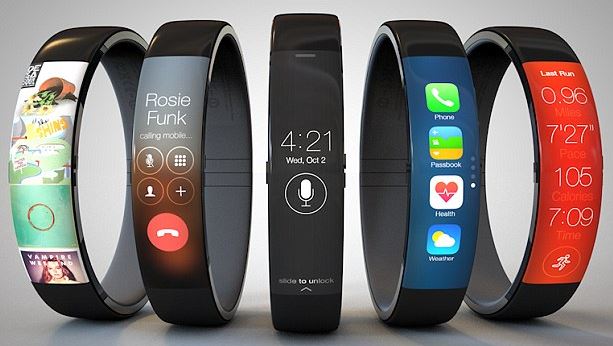
  • Enables health providers to take advantage of the sensors in iPhone 6 and the iWatch (coming soon).
  • Will soon allow apps to sync with providers electronic health care records, with the aim of seamless integration.

There is no doubt that Apple aims to be the “hub” for health care data. The Apple alliance with IBM will also lead to a significant influx of healthcare mobile apps for the iPhone and iPad.

Google has announced “Google Fit”, which is a health platform similar to Apple Health Kit that allows various apps to share health data for individual users to create a complete picture of their fitness. Whilst the open platform is soon to be released, it looks set to provide developers a single set of API’s to access and store fitness data from apps and sensors. Like Apple, this will eliminate the complexity of accessing multiple sources of information to provide a unified view of fitness activity & overall health.

With the increasing number of seniors going on line and their growing acceptance of technology to help manage and enhance health outcomes, combined with the development of platforms that bring all health data together by integrating apps, hardware and systems, we are positioned for a transformation in electronic healthcare opportunities and management.

So where does this leave us as Healthcare and IT leaders?

  • It’s time for a strategy refresh!!! People of all ages (including the older folk) are ready to embrace technology to improve and maintain their health. Ignore these trends at your own peril, and instead look to develop strategies that leverage mobile health app platforms. Depending on your situation, you may need to weigh up the benefits of building your own independent app versus building an app on an existing health platform.
  • Consider the opportunities for integrated medical records. Look at opportunities to use these mobile platforms to provide a more integrated solution that, at the end of the day, will ultimately assist the end user to view all their medical data in one place.
  • A greater number of sensors and integration points results in more data. As vast amounts of this user-generated data is collected there will be opportunities to monetize that data.
  • Telehealth, remote monitoring, telecare – Patient care will become less complex and more affordable with an increased number of devices and software able to connect and integrate seamlessly.
  • Issues around security, privacy, consent and ethics still need to be considered.

For more information, please feel free to contact me.
iwatch


1 Comment

Posted by on August 21, 2014 in e-health, mobility, strategy


Tags: , , , , , , , , , , , , , , , , , , ,

Mobile Health Applications – Trends and Predictions

The concept of using mobile applications to manage medical conditions and improve health outcomes is well and truly here.

The 4th mHealth App Developer Economics Study (www.mhealtheconomics.com) conducted in Q1 2014, outlines the major trends and direction relating to the mobile health landscape, and confirms the view that mobile health applications will continue to break new ground in terms of innovation, market penetration and change.

The proliferation of smartphones has provided the medium on which mobile health applications are consumed. If we turn the clock back to 2009, only 13% of all handsets shipped were smartphones. Today, smartphones have become the global number 1 connected device (mostly iOS and Android), whilst tablets are now outselling laptops. This means that, apart from some developing regions, almost everyone in the world has (or will have) a device that could run a mobile health solution.

In the Apple and Android app stores there are more than 100,000 apps within the health category. As the study points out, this is more than double the quantity of mobile health apps listed in the store only 2.5 years ago. More than 30% of all apps that are listed in the Health & fitness and Medical app sections are fitness trackers or exercise guides. The second and third largest groups are Medical Reference (16.6%) and Wellness apps (15.5%). Medical reference apps provide information about drugs, diseases, symptoms and give advice on how to take drugs or what to do in case of experiencing pain. They also show locations of pharmacies and medical centres/doctors. Medical condition management apps represent the 5th largest group of mobile health apps (6.6%).

Some of the predictions from the study participants (mobile health app publishers) paint an interesting picture about the future of the mobile health app market:

  • The main market drivers for health apps over the next 5 years are increasing penetration of capable devices and user/patient demand.
  • The potential show-stoppers are lack of data security and standards, and poor discoverability. This could leave room for specialised mobile health app stores.
  • Android and iOS are the dominant mobile platforms for which mobile health app developers will continue developing their apps in the next 5 years.
  • Fitness apps are believed to diminish in their relative importance. In five-years’ time they are expected to go from 1st to 5th position in terms of business potential. The app categories that have the highest expected market potential in the near future are remote monitoring and consultation apps.
  • The areas that are predicted to have the greatest impact on healthcare include improved outcomes of treatments, self-care of people, slowing down the increase of healthcare costs, improved interaction between patients and doctors, and enabling patients to take better care of their own health.

Many of the most popular mobile health apps today draw data/information from different sources to provide an enriched and comprehensive experience to users. This occurs through the use of “APIs”. These API’s are connectors that allow apps to import or export general health information (e.g., databases for drugs, food, diseases), personal health information (e.g., calorie intake, steps, weight), and medical device information (e.g. from glucometers, blood pressure monitors, heart rate monitors, step tracking bracelets).

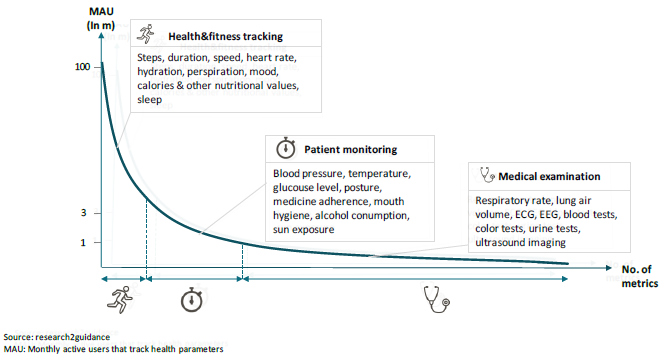
Three different categories of vital parameters are captured today are health & fitness tracking data, patient monitoring data, and medical examination data.

pic

With “consumer directed care” models now part of the health landscape, mobile healthcare apps form part of the solution to empower users/patients to take a more active role in their treatment process. The opportunity is ripe for mobile health to form an integral part of the nation’s healthcare strategy.

In the next 5 years there will be increased prevalence of sensor networks (wearable and built-in sensors). Sensors can have a tremendous impact on the mHealth industry and on how patients track their vital data in the future.

Companies like Apple, Google and Samsung are incorporating more and more sensors into their devices. These companies are seeing the potential in mobile health development, and investing heavily. In May 2014, Reuters reported that Apple has been on a biomedical technology hiring spree. Much of the hiring is in sensor technology, an area Chief Executive Tim Cook singled out last years as primed “to explode”. Recent reports suggest that Apple is developing a smart home platform to enter the Internet of Things space and an iOS application called Healthbook to help users track their heart rate, blood pressure and more. Industry insiders say the moves telegraph a vision of monitoring everything from blood-sugar levels to nutrition, beyond the fitness-oriented devices now on the market. Apple has also poached biomedical engineers from companies including Vital Connect, Masimo Corp, Sano Intelligence and O2 MedTech. Masimo is best known for its pulse oximetry device, which non-invasively measures patients’ oxygen saturation, an indicator of respiratory function. Vital Connect focuses on tracking vitals like heart rate and body temperature. O2 Med Tech also is experimenting with biosensors and developing new devices.

“Internet of Things” and “Big Data” anyone?

 
1 Comment

Posted by on June 2, 2014 in e-health, mobility


Tags: , , , , , , , , , , ,

e-Health and Mobility – Strategy in a Nutshell

There are some staggering statistics recently released by Forbes regarding smartphones and apps. According to Forbes (www.forbes.com) there will be 1 billion smartphones sold in 2013, which is twice the number of PC’s predicted to be sold that year.  By 2016 there will be 10 billion mobile internet devices used globally, which is 50 times the size it is today.  Between 2010 and 2011 the time spent on mobile apps began to outpace the time spent on the desktop or mobile Web.  In the same time period there was a 91% increase in the time users spent on mobile applications. By 2015, mobile application development projects targeting smartphones and tablets will out-number native PC projects by a ratio of 4-1. Between 2009 and 2014 the market for cloud-based mobile apps is projected to increase by nearly 90%.

So what does all this mean ???

The mobile revolution is well and truly here. Organisations of all sizes need to have developed a solid and robust mobile strategy, or face being left behind by clients and competitors.  Whilst there is still some contention over the best strategic approach to mobile application development, there is no doubt that mobile applications are front and centre in leveraging market opportunities, client engagement, process efficiencies, and strategic innovation.

In a recent blog post I proposed the inclusion of a Mobile Enterprise Application Platform (or MEAP) as an integral part of any mobile strategy. Of course, this particular strategy depends on the nature of the organisation and its key mobility objectives; however MEAP should not be overlooked when considering a long term view to deployment of multiple different mobile applications, using multiple back-end systems, across any device.

For medium to large sized healthcare organisations, a MEAP based mobile strategy has several advantages over a natively developed application, which is often built with a pre-defined range of objectives, or based on one back-end system.  In this scenario, a mobile platform approach is superior because it:

–          Enables the organisation to customise a solution into fit exact requirements, tailored to the business needs and processes

–          Can provide a competitive advantage, as no one else has that particular mobile application

–          Ensures that changes to the mobile solution are immediate, flexible and more cost effective

–          Is not restricted by the type of mobile device. Mobile platform applications built using HTML5 ensure availability on any mobile device

–          Aligns to organisational “bring your own device” policies (if applicable)

–          Ensures that any development code (apps or API’s) can be re-used to help build other apps

–          Fits into the organisations long term strategies and e-health vision to provide mobile solutions for other uses, for example

      • Bedside medication management
      • Bedside electronic progress notes and electronic care planning
      • Capturing of client and staff incidents, risks, compliance and improvement initiatives
      • Mobile business intelligence and analytics
      • Mobile clinical assessments
      • Information management (eg, mobile access to policies or corporate documents)
      • Others ???

The above examples are likely to need data integrated from multiple in-house systems, which plays into the hands of a mobile platform. While organisations may not require mobility solutions for all the above examples right now, establishing a mobile platform caters for immediate AND long-term organisational use of mobility, even if the future state is not known.  The mobility platform approach has already harnessed recognition across all the major ICT industry research groups including Gartner and Forrester, and is a key component of the ICT Strategy toolkit.

 
4 Comments

Posted by on November 30, 2012 in e-health, mobility


Tags: , , , , , , , , , , , , ,

Mobile app strategy – what approach is right for you ?

The mobile application revolution is here.  Apple’s app store reached 25 billion downloads this year and offers more than 700,000 apps. In addition, there are more than 600,000 apps available on the android store. Organisations are realising huge potential by utilising apps to entice customers, create market awareness, provide information, remain relevant, be competitive, increase efficiencies, and enhance productivity.  With the popularity and promise of mobile applications, organisations who fail to have a defined mobile strategy will not realise the competitive edge that come with the mobile application revolution.

A key part of an organisations mobile strategy is consideration for how mobile and web applications can be built and delivered. The three most popular approaches are:

1.  Native App

  • A native application is specifically developed for a particular device and mobile operating system (eg, the app is solely developed for either android, apple, blackberry, or windows devices/systems). Native apps provide the best user experience, performance, and access to device functions (eg camera, contacts, etc)

2.  Mobile Web

  • Mobile web apps can run in most browsers on most devices. For example, a web app for an iphone would run in Safari. A web app for a windows mobile phone would run in Internet Explorer. The disadvantage is that they are limited by the capabilities of the browsers they run in, so are currently unable to access all the features and functions on the local device (eg camera, geolocation, etc). The app itself isn’t actually downloaded onto the device, so there is no software or app to install. Mobile web apps have inferior performance compared to native apps.

3.  Hybrid

  • Hybrid apps provide the best of both worlds. Like mobile web apps, hybrid apps can run in most browsers on most devices on the single code base, and gives access to all of the device features.
 

Native

Mobile Web

Hybrid

App performance

Excellent

Good

Very Good

Development speed

Difficult

Fast

Moderate

Can run on multiple devices / platforms

No

Yes

Yes

Device access (camera, gyroscope, accelerometer, etc)

Full access

Partial Access

Full Access

Offline access

Yes

Yes

Yes

Reuse source code for other applications

No

Yes

Yes

Allows for “Bring Your Own Device” (BYOD)

No

Yes

Yes

Advantages Great performance.

Rich user interface

Can use all device features

App runs on any device

Fast development

Simple maintenance

No need to install new software

Updates appear automatically

All users on same version

App runs on any device

Fast development

Can use all device features

All users on same version

Disadvantages One app developed per platform/device

Users must manually download & install app updates

Users may ignore updates, resulting in different app versions

Has limited device access

Slower performance

Very good performance, but not as good as Native

The most appropriate mobile development approach for an organisation depends on the requirements and intended use of the app. As discussed in an earlier blog, research firm Gartner developed a concept called “the rule of three”, where they encourage companies to consider the mobile platform (web/hybrid) approach to mobility when they need their mobile solutions to:

–          Support three or more mobile business applications

–          Support three or more mobile operating systems

–          Integrate with at least three back-end data sources

So the choice of app development strategy you make depends on what you wish to do with the app, your organisations long term vision, the underlying business and functional requirements and intended use of the app.

 
1 Comment

Posted by on September 28, 2012 in mobility


Tags: , , , , , , ,

Do we really need to upgrade to the iPhone 5 ?

It’s that time of year when employees work phones take a swim in the pool, get run over by the car, eaten by the dog or are accidently dropped from a great height. Yes, the new iteration of the iPhone is soon to be released, and employees will be keen to get their hands on the latest smartphone from Apple. Whether many of us like it or not, with each new release of the iphone or ipad, organisations are becoming more entrenched with these devices. A survey from Consumer Intelligence Research Partners found that 20% of consumers who brought the 3rd generation iPad plan to use the device for business. So it’s only a matter of time before the iPhone 5 makes its way into organisations.

The question is, will the iPhone 5 actually be better for business ?

With a faster processer, more memory and a bigger (4 inch) screen, you may argue that we will be more easily able to consume corporate data. A bigger screen will definitely help with looking at corporate information, business data, dashboards, emails, analytics (not to mention games and the internet). The iPhone 5 is also more capable of streaming media and consuming media-rich mobile apps, and is a more robust and sturdy device thanks to the aluminum backing (which may or may not help with breakages when the iPhone 6 is released !!!).

Are these improvements enough to justify the price premium over purchasing a iPhone 4 or iPhone 4s ?

The premium we currently pay is around $250 for the honor of having a iPhone 5 rather than an iPhone 4. The answer relates to many factors including how the device is used, the content that is consumed on the device and the processes/rules in place around purchasing. An iPhone 5 will certainly satisfy the hunger of those Executives who relish new technology, however making the switch is most likely to be a decision based on individual business circumstances. It may be challenging for organisations to justify the price premium against the benefits received for moving to the iPhone 5.

 
1 Comment

Posted by on September 19, 2012 in mobility


Tags: , , , , , , ,

Does your Mobile Strategy have MEAP ?

Significant growth is forecast in the use of Smartphones worldwide. With this growth in Smartphone use comes an increase in the consumption of mobile applications.

Many businesses have already jumped (or are in the process of jumping) onto the mobile development bandwagon to take advantage of the opportunities and innovation that mobile applications can deliver. Take Dominos Pizza for example. Dominos embraced mobile as a way to enable customers to place orders, and now has more than 30% of their orders placed online or from their smartphone app.

Failure to have a well-considered mobile strategy could make or break business, so it’s important to get it right. One consideration that is gaining momentum at the moment is Mobile Platform as a Service – or a “Mobile Enterprise Application Platform” (MEAP). The MEAP term was originally coined by Gartner, and is a serious alternative to developing bespoke mobile apps. MEAP’s offer fast development, and can be delivered across multiple platforms without the need to re-engineer code. In other words, companies can use a MEAP to develop the mobile application once and deploy it to a variety of mobile devices (including various smart phones, tablets, notebooks, handhelds etc) with no changes to the underlying business logic. This makes it easy to align with your BYOD strategy. MEAP’s can be made available in online and offline mode, and are great for organisations who wish to deploy multiple applications on a single infrastructure.

So, who should consider MEAP as part of their mobile strategy ?

Gartner developed a concept called “the rule of three”, where they encourage companies to consider the MEAP approach to mobility when they need their mobile solutions to:

  • Support three or more mobile business applications
  • Support three or more mobile operating systems (OS)
  • Integrate with at least three back-end data sources

I am currently in the process of sourcing trusted Australian based MEAP providers. If you know of any, I would greatly appreciate if you could get in touch.

 
2 Comments

Posted by on July 30, 2012 in mobility


Tags: , , , ,