RSS

Category Archives: innovation

Digital Trends & Digital Leadership

What are the key digital trends of 2019, and what are the key traits of successful “digital leaders”?

  1. Digital Trends

Research recently released by Harvey Nash/KPMG, Info-Tech, Gartner and Deloitte have highlighted a mostly shared view of of current and future technology focused trends. The research demonstrates that organisations are changing their product/service offerings or business models in a fundamental way, predominantly driven by digital disruption and the need to get closer to the consumer. 

The combined research demonstrated an increased investment in cyber security, data analytics, AI/automation and transformation. Organisations not investing in AI and automation can expect, over time, for their cost base to be relatively higher than their AI-investing competitors.

The combined summarised view of digital trends is shown in the table below:
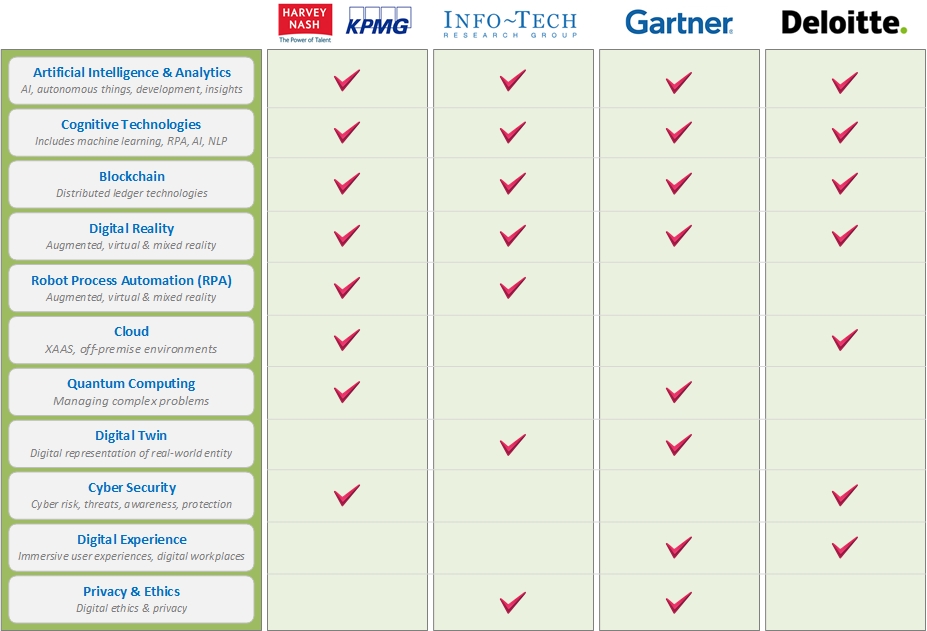
Digital trends where 2 or more trends were featured across the four sources

Digital transformation is becoming business as usual as enterprises look to stay ahead of the game. It has been recognized that digital transformation should and can be handled within existing budgets and without extra investment. 

Digital transformations should be business led rather than IT led, to ensure business leaders are fully engaged with how their operations should be optimized for automation and digital change.

2. Digital Leadership

Leading organisations who demonstrate strong digital leadership experience improved time to market, superior customer experience and high operational efficiency. As a result, both revenue growth and profitability are higher too. Today, there is no longer business strategy and technology strategy. There is just strategy, and technology is driving it.

Digital leaders, as opposed to the Digital Management mainstream, have several traits that set them and their organisations apart from the rest. Digital Leaders distinguish themselves as being more outward-looking, using technology as a means of breaking into new markets, engaging with customers and gaining market share. They also tend to have different operating models that focus on the business owning and leading aspects of technology delivery in collaboration with IT.

Digital leaders:

  • Implement new technologies end-to-end across functions and geographies and change the ways of working to maximise value from technology. They use cross-functional teams (IT and business staff) and ensure business leaders work collaboratively to deliver technology change
  • Report business outcome-based metrics for technology projects, and scale up projects quickly if the project is successful or stop quickly if it isn’t.
  • Integrate core business systems with newer digital solutions and bring a long-term ‘product’ rather than a short-term ‘project’ mindset to technology implementation. They employ automation in software development and maintenance, and use methodologies such as agile and DevOps to speed up project delivery
  • Ensure that non-IT staff have the right technology skills, and use both internal and external resources to access the right skills
  • Maximise value from the data they hold and maintain an enterprise-wide data management strategy
  • Identify and manage the key security and privacy issues across technology development and operations, and build customer trust through the service delivered to customers and end user

In essence, digital leadership is about prioritizing value creation over efficiency generation, with a focus on speed and agility. The role is that of influence and partnering with the business rather than about control.

According to Harvey Nash / KPMG, the top 5 Board Priorities for digital leaders are:

  1. Developing innovative new products and services
  2. Delivering consistent and stable IT performance to the business
  3. Enhancing the customer experience
  4. Improving business processes
  5. Increasing operational efficiencies
 

Tags: , , , , , , , , , , ,

2017 Strategy Considerations

2017 Strategy Considerations


This post explores some key innovations and technologies that are worthy of consideration for strategy planning in 2017 and beyond. Whilst each of the technology innovations are at different stages of maturity, hype and utilisation in the market, each should be considered for their potential uses and applicability as part of blue-sky innovation and strategic planning processes.


Artificial Intelligence and Machine Learning

Artificial Intelligence and machine learning include systems that appear to learn, understand, predict and operate with minimal (or no) human guidance. These characteristics make machines appear intelligent. Smart machines intelligent applications can change their future behaviour through learning. Real world examples include robots, autonomous vehicles, drones and virtual personal assistants, intelligent sensors, smart appliances and smart tools (such as a digital stethoscope).


The New “Realities” – Virtual and Augmented

Virtual reality (VR) is essentially technology that generates a virtual environment, and simulates a user’s physical presence in this environment through interaction. The virtual environment is separate from the real-world environment, and headwear is typically used to shut-out the immediate surroundings from the virtual world. In a work environment VR can be very beneficial for training, where staff can develop skills in the virtual world without the real-world consequences of failing.

Augmented reality (AR) overlays virtual objects with the environment around you. Unlike virtual reality, which creates a totally artificial environment, augmented reality uses the existing environment and overlays new information on top of it. The most well-known real-world example is Pokomon Go. Other examples include the Topshop AR dressing rooms which allows shoppers to virtually try on new clothes. There is also the Shisedio makeup mirror, the IKEA AR catalogue (to visualise how various furniture would look inside your home) and the IBM shopping app, which provides personalised information whilst browsing the shelves.


Mobile Wallet

The use of mobile wallets is continuing to go mainstream, and fully integrated mobile wallets are starting to become a reality. Mobile wallets store payment credentials to enable users to authenticate themselves and/or make transactions from a mobile device. The credentials can be payment-related, such as a bank card, bank account or prepaid card, or non-payment-related, such as a loyalty card or mileage card. There are also closed wallets that allow use at specific merchants and open wallets that allow use at many other merchants. Businesses, retailers and organisations need to embrace this change, and identify the opportunities and risks of the technology.


Natural Language Question Answering

Natural-language question answering (NLQA) technology is a type of natural-language processing technology, composed of applications that provide users with a means of asking a question in plain language. A computer or service can answer it meaningfully, while maintaining the flow of interaction.

Unlike information retrieval systems such as search engines, NLQA aims to supply users with “just the right information” instead of merely providing a list of hits. NLQA technology is improving at a rapid pace. Current day examples include SIRI, Cortana and GoogleNow, however they are more like voice assistants and text analysers than true NLQA systems. Future uses in business include the use of NLQA in answering customer queries, contact centre applications and staff training.


Analytics

Analytics comes in many variants. Some examples are predictive, prescriptive, real-time, graph, personal and embedded analytics. It is no secret that the use of analytics and business intelligence in helping make and shape business decisions is critical for all organisations. Analytics can be used to transition organisations from a reactive to a proactive mode of operations and must be considered a core enabler of strategic and operational development.


Geospatial and location intelligence

Geospatial and location intelligence (GLI) includes applications, infrastructure and tools that enable access to, and utilisation of, geospatial and location data of people, things and information for location-referenced information analysis.

It is estimated that 80% of all business data contains a location component. It is therefore critical to understand how location affects business. Properly analysing location can provide insights that support and improve decision making in virtually anything, including marketing and supply chain logistics and operations. Location intelligence involves layering multiple data sets spatially and/or chronologically, for easy reference on a map.

Location intelligence complements business intelligence – where business intelligence may find one-dimensional relationships between customer demographics or store and warehouse locations, location intelligence enables much deeper dives into the relationships between geography and customer data.


Blockchain

Blockchain is a type of distributed ledger technology where transactions are sequentially grouped into blocks. Blockchain is used to track the ownership of assets without the need for a central authority, which speeds up transactions and cuts costs whilst lowering the chance of fraud. Blockchain is widely known as the technology that underpins the digital currency bitcoin. Whilst blockchain is still a relatively new and experimental technology, the ecosystem is growing rapidly and includes start-ups to major technology vendors.

Blockchain comes with cautions however. Considerations include potential lack of transparency, limitations concerning consumption of resources, operational risk from unintended centralisation of resources; and lack of alignment to existing legal and accounting frameworks. There are also potential adoption challenges, including the lack of standards, robust platforms, scalable distributed consensus systems and interoperability mechanisms.


Unmanned Aerial Vehicles (UAV’s)

UAV’s include miniature helicopters, airplanes and multirotors that can be remotely controlled by human pilots on the ground or outfitted for autonomous navigation and used to perform aerial surveillance. UAVs typically incorporate GNSS, camera, sonar sensors and navigation systems that guide them for imaging, thermal and spectral analysis. Memory caches and communications links allow UAVs to collect and transmit datasets, as well as transfer them to the cloud for record or instance calculation.

More and more commercial applications for UAV’s are emerging, and there is an increasing number of investments made in UAV start-ups and big companies. Practical examples of commercial UAV applications include parcel delivery, pipeline inspection, disaster inspection, security inspection, and agriculture inspection.


Leave a comment

Posted by on December 15, 2016 in innovation, strategy, technology


Tags: , , , , , , , , , , , , , ,

Business Transformation – Turning Digital Thinking into Digital Reality

Business Transformation – Turning Digital Thinking into Digital Reality

The digital revolution is here – it is essential for organisational survival, and is now a natural expectation of staff, customers, managers, boards and industry partners.   Failure to embrace digital disruption will ultimately result in significant impacts to organisational efficiencies (at best), or will ultimately lead to organisational demise (at worst).

Organisations are using technologies like social media, mobile, analytics and embedded devices to change their customer engagement, internal operations and even their business models. Whilst there are many organisations that are realising real benefits, many organisations are left wondering how to start the journey, or how to successfully execute a digital transformation.

Based on various studies, research and personal experience, the following key practices are critical in enabling organisations to undertake successful digital transformation:


1.  Develop a Vision

Senior leaders need to have a common vision of how to proceed, and weed out the activities that run counter to that vision. They also need to understand why to change, and how the future will be better than the current situation. Without a vision of change, employees tend to do what they have been doing for years, even if it is no longer useful in the digital world. The first step is to understand the threats and opportunities that digital represents to the organisation. Will existing ways of working continue to be effective in a digital world? Are there new opportunities available in customer experience, operational processes or business models? It is also important to assess the organisations digital maturity.

Organisations must change the approach from supporting the business with information technology, to identifying what is possible with digital – starting with mobility, cloud, situational context, and then consider how to get there from here using technology as the catalyst.

2.  Invest in Digital

To realise the digital vision, organisations must invest in the right areas. This includes cutting back in unproductive areas while ramping up investment where it needs to occur. Organisations should choose to excel in a few areas based on existing capabilities such as customer experience, social media, mobile, customer analytics, process digitization or internal collaboration – but not in all.

Organisations will need to consider adapting their business model, which could include adding value to products and services, reaching new customers, linking operational and customer-facing processes in new ways, and even launching entirely new businesses. Strong governance mechanisms are also required to increase the level of coordination and sharing across silo-run digital initiatives.

3.  Organisational Engagement

When employees are engaged in a shared vision they help to make the vision a reality. They offer less resistance to change and often identify new opportunities that were not previously envisioned. It is beneficial to use a wide array of digital channels, such as broadcast, web, video, and social networks to generate continuous two-way communication at scale. Equally important is to encourage employees to identify new practices and opportunities that will advance the vision.

4.  Customer Focus

From a digital solution perspective, focus on user experience design by directly engaging with your customer base. Ask for feedback, challenge current processes, and validate effectiveness. Provision of products or services can be enhanced by engagement with the customer base to understand the demand, and include co-design, enabling greater take-up and the ability for self-service. Provide access to your products and services from anywhere, anytime and on any device, regardless of location.

5.  Cloud First

Investment in cloud based platforms can accelerate the journey to digital, providing opportunities for simplified mobile platform interfaces, use of contextually aware services (utilising customer location, preferences, usage history, etc), context sensitive data integration and data exchange among mobile, big data analytics, social media, internet of things, etc. Develop capabilities to generate forward-looking predictive analytics and overlay with open data sources to truly innovate and provide value.

6.  Sustain the Transformation

Successful digital transformation is built on a foundation of core skills and capabilities. Assess the skills on your teams to insure they fit the new platforms for digital business. Consider hiring some experienced executives who can make an impact quickly and coach existing employees. Redesign your training programs to develop skills your company needs. Where useful, partner with vendors to gain skills and cross-sector experience that complements your capabilities. Senior leaders must focus on building and sustaining momentum for change.

Quantify and monitor progress toward the digital ambition through KPIs or digital scorecards. Scorecards have power beyond just measuring the impact of major investments. They help to change the culture. A shared understanding between IT and business executives is also critical to success.


For a real-world case study (from independent research firm Gartner), please see the link below or contact me via email, linkedin, twitter or this post.

Building a Digital House: How an Industry Regulator Created an Exemplary Public-Sector Digital Service Model


Tags: , , , , ,

Technology Trends 2015 – The CIO Perspective

Technology Trends 2015 – The CIO Perspective

Early in 2015 Deloittes published their sixth annual Technology Trends report (Tech Trends 2015: The fusion of business and IT).  This publication identifies the eight technology trends that have the most potential business impact over the next 12 to 24 months for technology and business.

Reading through the entire report may not appeal to all audiences, so I have attempted to distil the most relevant take-away points from the perspective of the CIO. What does this actually mean on a day-to-day basis? What aspects of this report deserve serious consideration and action for strategy and planning?


  1. CIO as a Chief Integration Officer

In brief:  The CIO role is evolving, with integration at the core of its mission. CIO’s need to harness emerging disruptive technologies for the business while balancing future needs with today’s operational realities.

Actions:

  • Engage leadership resources to solicit feedback and understand priorities
  • Tap into ideas through new employee and partnership channels
  • Prototype and demo to make the possible become feasible
  • Evaluate the current positioning, and understand the balance sheet of IT
  • Invest in underlying capabilities to improve efficacy


  1. API Economy

In brief:  Application programming interfaces (API’s) are the key to integration, exposing core business assets for reuse, growth, and innovation.

Actions:

  • Have a clear API strategy to define the intention, value and audience of the API.
  • Establish ownership by placing effort under an IT executive to simplify the path forward
  • Evaluate the available tools, platforms and integration possibilities
  • Plan big, start small. Businesses should balance payoff with added complexity
  • See it through. Drive a sustained campaign for awareness and support, while keeping ongoing documentation and maintenance needs in mind.


  1. Ambient Computing

In brief: Harnessing the real potential of the Internet of Things. From the growth of embedded sensors and connected devices, focus on translating the possibilities into real business impact.

Actions:

  • Beware of fragmentation. Use cases will require cross-organisational collaboration
  • Avoid distractions from exciting new technologies by starting with concrete business outcomes.
  • Usability should guide implementation, even if the solution is automated
  • IoT standards are evolving. Don’t wait to invest until the standards are finalised – help shape them.


  1. Dimensional Marketing

In brief:  A new vision for marketing is being formed as CMO’s and CIO’s invest in technology to reach digitally connected customers. CIO’s can help deliver analytics, mobile, social and web.

Actions:

  • Understand the customer journey and focus on authentic engagement
  • Big data and predictive analytics should play a role in how you invest in targets and priorities
  • Have a holistic approach – explore new channels and tools to complement existing ones
  • Authoring, provisioning and measuring usage and effectiveness should be seamless processes that provide users with contextual content across channels
  • Social activation – move beyond passive listening to inspiring brand ambassadors


  1. Software-Defined Everything

In brief: The entire operating environment (server, storage, and network) can now be virtualized and automated.

Actions:

  • Employ standardised design techniques. Emphasise templates and commonality to manage complexity
  • Infrastructure and application teams should work in tandem for rapid deployment
  • Every asset/application should be analysed to determine technical considerations for migration
  • Some vendors may accommodate creative financing arrangements
  • Consider potential benefits in coupling SDDC initiatives with broader IT transformation effort


  1. Core Renaissance

In brief: Use existing investments in core systems to form the foundation for growth and new service development. Modernise systems, re-platform solutions and extend legacy systems to fuel new services & offerings.

Actions:

  • Have a plan – balance business needs with limitations of existing systems and potential of emerging technology
  • Invest deliberately in the core to eventually become a catalyst for growth
  • Partner with strategic venders to explore new solutions for existing issues
  • Embrace a living approach to architecture with usability, integration, data and security in mind
  • Find a burning platform to move the conversation about the core to the centre stage


  1. Amplified Intelligence

In brief: Companies are applying machine learning and predictive modeling to large and complex data sets. Artificial intelligence is now a reality that is not about replacing workers, but augmenting their capabilities. Advanced analytics can help amplify our intelligence for more effective decision making.

Actions:

  • Develop a wish list to guide priorities and reveal what data is needed
  • Balance opportunity against expected organisational resistance.
  • Let user experience dictate the format, granularity and decisiveness of insights
  • Be transparent in intent, and consider programs to re-tool and redeploy workers


  1. IT Worker of the Future

In brief:  Technical talent is scarce, the legacy-skilled workforce is retiring, and skills are needed in the latest emerging, disruptive technologies.  Companies need to cultivate the IT worker of the future, with habits, incentives and skills that are inherently different from those in play today.

Actions:

  • Incentivise IT leaders
  • Rethink hiring. Include externships, hackathons, and recruit those with design aptitude
  • Introduce mechanisms to submit, explore, and develop new ideas
  • Create a virtual culture – provide tools that support remote workers
  • Leverage crowdsourcing, incubators and start-up spaces
  • Invest in your own IT workforce to drive retention and encourage referrals


Exponentials

In brief: Science and technology breakthroughs advancing faster than Moore’s law. Fields include: artificial intelligence; robotics; additive manufacturing; quantum computing; industrial biology; cyber security.

Four dimensions for effective innovation strategy:

  • Trend sensing: stay on top of new developments. Use “show” versus “tell” in demos and prototypes
  • Ecosystems: combine the traditional allies with entrepreneurs, start-ups, venture capitalists, etc
  • Experimentation: fail fast and cheap, move forward, and think about the impact, feasibility and risk
  • Scaling edges: achieve innovation by establishing new teams on the fringes of the organisation
 
Leave a comment

Posted by on May 12, 2015 in general, innovation, strategy


Tags: , , , , , , , , , , , , ,