RSS

Category Archives: digital

Digital Trends & Digital Leadership

What are the key digital trends of 2019, and what are the key traits of successful “digital leaders”?

  1. Digital Trends

Research recently released by Harvey Nash/KPMG, Info-Tech, Gartner and Deloitte have highlighted a mostly shared view of of current and future technology focused trends. The research demonstrates that organisations are changing their product/service offerings or business models in a fundamental way, predominantly driven by digital disruption and the need to get closer to the consumer. 

The combined research demonstrated an increased investment in cyber security, data analytics, AI/automation and transformation. Organisations not investing in AI and automation can expect, over time, for their cost base to be relatively higher than their AI-investing competitors.

The combined summarised view of digital trends is shown in the table below:
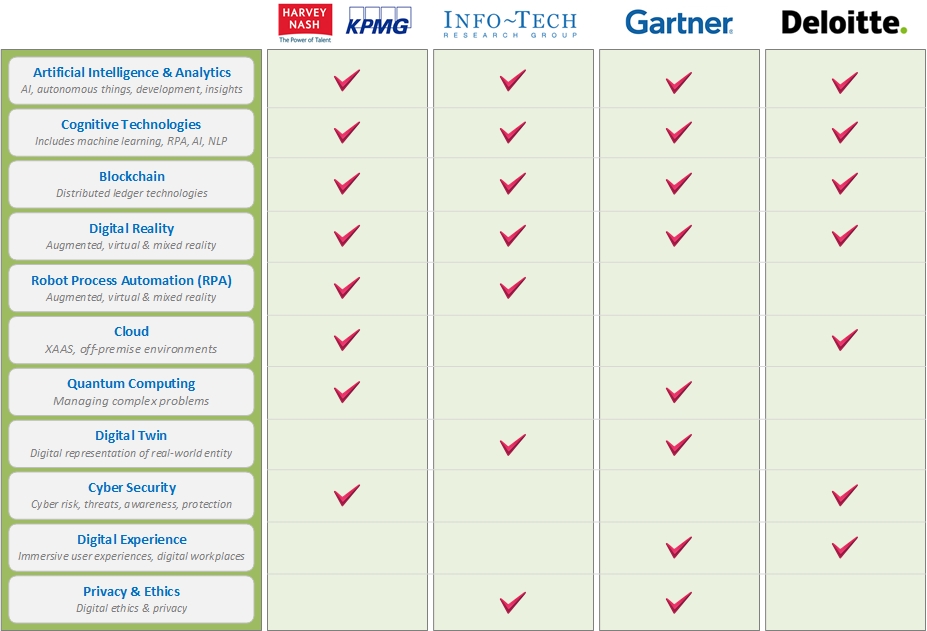
Digital trends where 2 or more trends were featured across the four sources

Digital transformation is becoming business as usual as enterprises look to stay ahead of the game. It has been recognized that digital transformation should and can be handled within existing budgets and without extra investment. 

Digital transformations should be business led rather than IT led, to ensure business leaders are fully engaged with how their operations should be optimized for automation and digital change.

2. Digital Leadership

Leading organisations who demonstrate strong digital leadership experience improved time to market, superior customer experience and high operational efficiency. As a result, both revenue growth and profitability are higher too. Today, there is no longer business strategy and technology strategy. There is just strategy, and technology is driving it.

Digital leaders, as opposed to the Digital Management mainstream, have several traits that set them and their organisations apart from the rest. Digital Leaders distinguish themselves as being more outward-looking, using technology as a means of breaking into new markets, engaging with customers and gaining market share. They also tend to have different operating models that focus on the business owning and leading aspects of technology delivery in collaboration with IT.

Digital leaders:

  • Implement new technologies end-to-end across functions and geographies and change the ways of working to maximise value from technology. They use cross-functional teams (IT and business staff) and ensure business leaders work collaboratively to deliver technology change
  • Report business outcome-based metrics for technology projects, and scale up projects quickly if the project is successful or stop quickly if it isn’t.
  • Integrate core business systems with newer digital solutions and bring a long-term ‘product’ rather than a short-term ‘project’ mindset to technology implementation. They employ automation in software development and maintenance, and use methodologies such as agile and DevOps to speed up project delivery
  • Ensure that non-IT staff have the right technology skills, and use both internal and external resources to access the right skills
  • Maximise value from the data they hold and maintain an enterprise-wide data management strategy
  • Identify and manage the key security and privacy issues across technology development and operations, and build customer trust through the service delivered to customers and end user

In essence, digital leadership is about prioritizing value creation over efficiency generation, with a focus on speed and agility. The role is that of influence and partnering with the business rather than about control.

According to Harvey Nash / KPMG, the top 5 Board Priorities for digital leaders are:

  1. Developing innovative new products and services
  2. Delivering consistent and stable IT performance to the business
  3. Enhancing the customer experience
  4. Improving business processes
  5. Increasing operational efficiencies
 

Tags: , , , , , , , , , , ,

Customer Experience & Technology

Customer Experience & Technology

Every organisation has a different array of stakeholders, whether it be customers, staff, consumers, suppliers, the Board, shareholders, clients or owners.  Each of these stakeholders have different needs and expectations. For example, customers may want great service or excellent value, staff may want certainty and to be paid well for what they do, and shareholders may seek a solid return on their investment.  As professionals, we are there to help balance the needs of these stakeholder groups. At the end of the day, none of these groups would exist without the need for the service or product in the first place, and no business would survive without these consumers paying for (or being funded for) these products and services.

So, why would consumers spend money with your organisation, and keep on coming back?

Customer Experience

Happy customers receive a perceived value or benefit from purchasing a product or service. A core component of receiving value and benefits is through having a positive customer experience.

Positive customer experiences drive positive emotions, brand loyalty and referrals. For companies it is also shown to increase stock prices.  You enable trust in your brand by providing products and services which are timely, consistent, easy/simple, are of great value and meet needs of customers. Customer intimacy is also an important sustainable differentiator.

Two thirds of companies now compete on the basis of customer experience (and that figure is projected to increase).

So, how do we improve customer experience?

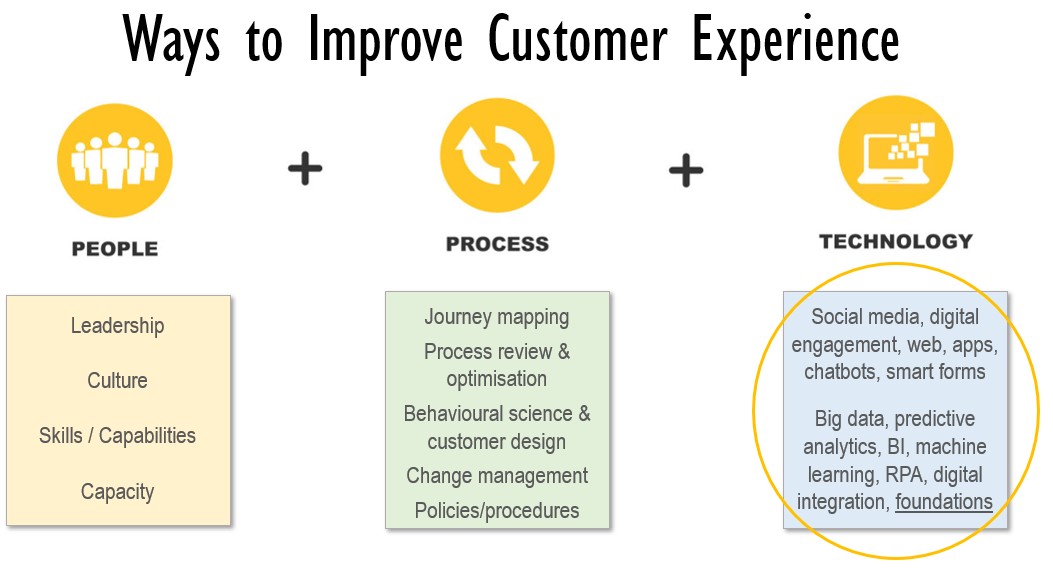
There are many ways to improve customer experience, some of which involve technology, all of which involve process change, people and leadership.

Technology is a significant enabler of customer experience but is certainly not the magic pill to address all customer experience challenges. For the perspective of the IT department and IT leader there is a need to reprioritise technology projects towards those that are geared towards providing better customer experiences. The technology department must work very closely with other areas of the organisation (such as HR, Marketing, PMO, etc) to make this happen and to ensure alignment of change.

The Approach

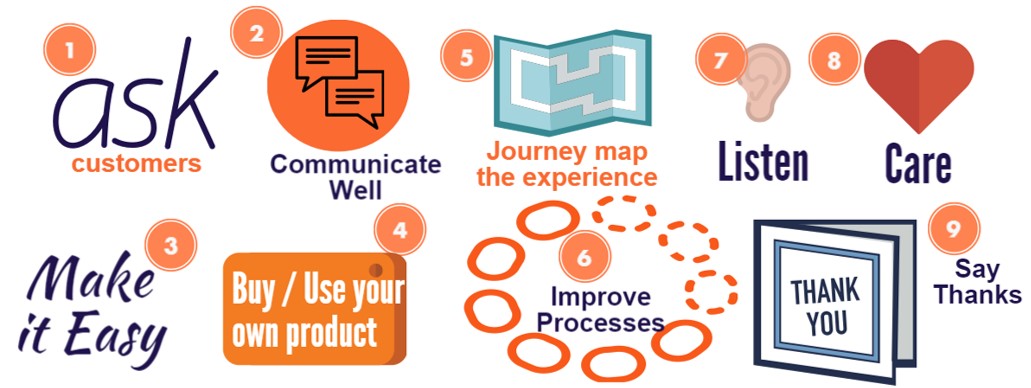
I believe the best approach is simply talk with people. Talk and (more importantly) listen to as many stakeholders as possible to find out what they do, how they do it, and what their challenges and pain points are.

Synthesize this information, along with research, experience and best practice to devise a plan, ensuring that the end goals and objectives were well defined and aligned to Corporate Strategy.

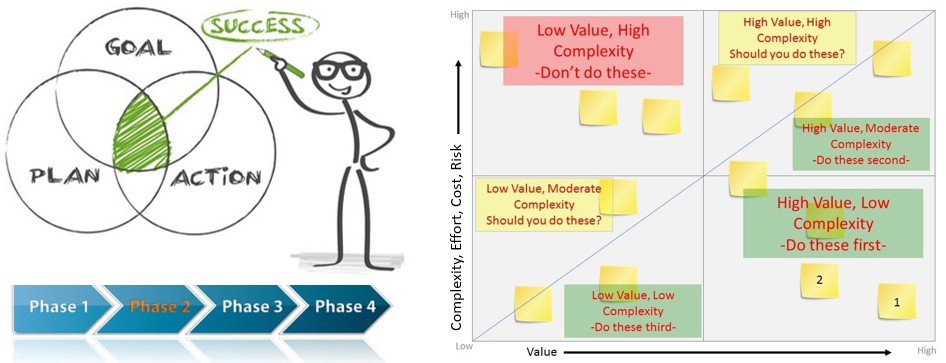
This should be broken into phases and prioritised based on costs, value for money, effort, complexity and risk.

In Summary

  • Identify the end goals & objectives. What are the problems you are trying to solve?
  • Liaise with key internal and external stakeholders
  • Develop a plan (aligned with corporate strategy) that includes:
    • An integrated approach to encompass people, process and technology
    • Customer experience (mostly external) and operational excellence (mostly internal)
    • Prioritisation of initiatives based on value, cost, risk, complexity, effort.
    • Identify low hanging fruit, quick wins, etc. Celebrate the wins. Be agile. Fail/learn fast.
  • Leadership, leadership, leadership (plus teamwork and accountability)
  • “Sell” the plan. It’s all about the people. Communicate as one with simplicity and meaning.
  • Change management. Answer the “what’s in it for me” question to improve change acceptance
  • Measure benefits and success. Reassess the plan and priorities regularly.

Train people well enough so they can leave, treat them well enough so they don’t want to

Richard Branson
 

Tags: ,

Business Transformation – Turning Digital Thinking into Digital Reality

Business Transformation – Turning Digital Thinking into Digital Reality

The digital revolution is here – it is essential for organisational survival, and is now a natural expectation of staff, customers, managers, boards and industry partners.   Failure to embrace digital disruption will ultimately result in significant impacts to organisational efficiencies (at best), or will ultimately lead to organisational demise (at worst).

Organisations are using technologies like social media, mobile, analytics and embedded devices to change their customer engagement, internal operations and even their business models. Whilst there are many organisations that are realising real benefits, many organisations are left wondering how to start the journey, or how to successfully execute a digital transformation.

Based on various studies, research and personal experience, the following key practices are critical in enabling organisations to undertake successful digital transformation:


1.  Develop a Vision

Senior leaders need to have a common vision of how to proceed, and weed out the activities that run counter to that vision. They also need to understand why to change, and how the future will be better than the current situation. Without a vision of change, employees tend to do what they have been doing for years, even if it is no longer useful in the digital world. The first step is to understand the threats and opportunities that digital represents to the organisation. Will existing ways of working continue to be effective in a digital world? Are there new opportunities available in customer experience, operational processes or business models? It is also important to assess the organisations digital maturity.

Organisations must change the approach from supporting the business with information technology, to identifying what is possible with digital – starting with mobility, cloud, situational context, and then consider how to get there from here using technology as the catalyst.

2.  Invest in Digital

To realise the digital vision, organisations must invest in the right areas. This includes cutting back in unproductive areas while ramping up investment where it needs to occur. Organisations should choose to excel in a few areas based on existing capabilities such as customer experience, social media, mobile, customer analytics, process digitization or internal collaboration – but not in all.

Organisations will need to consider adapting their business model, which could include adding value to products and services, reaching new customers, linking operational and customer-facing processes in new ways, and even launching entirely new businesses. Strong governance mechanisms are also required to increase the level of coordination and sharing across silo-run digital initiatives.

3.  Organisational Engagement

When employees are engaged in a shared vision they help to make the vision a reality. They offer less resistance to change and often identify new opportunities that were not previously envisioned. It is beneficial to use a wide array of digital channels, such as broadcast, web, video, and social networks to generate continuous two-way communication at scale. Equally important is to encourage employees to identify new practices and opportunities that will advance the vision.

4.  Customer Focus

From a digital solution perspective, focus on user experience design by directly engaging with your customer base. Ask for feedback, challenge current processes, and validate effectiveness. Provision of products or services can be enhanced by engagement with the customer base to understand the demand, and include co-design, enabling greater take-up and the ability for self-service. Provide access to your products and services from anywhere, anytime and on any device, regardless of location.

5.  Cloud First

Investment in cloud based platforms can accelerate the journey to digital, providing opportunities for simplified mobile platform interfaces, use of contextually aware services (utilising customer location, preferences, usage history, etc), context sensitive data integration and data exchange among mobile, big data analytics, social media, internet of things, etc. Develop capabilities to generate forward-looking predictive analytics and overlay with open data sources to truly innovate and provide value.

6.  Sustain the Transformation

Successful digital transformation is built on a foundation of core skills and capabilities. Assess the skills on your teams to insure they fit the new platforms for digital business. Consider hiring some experienced executives who can make an impact quickly and coach existing employees. Redesign your training programs to develop skills your company needs. Where useful, partner with vendors to gain skills and cross-sector experience that complements your capabilities. Senior leaders must focus on building and sustaining momentum for change.

Quantify and monitor progress toward the digital ambition through KPIs or digital scorecards. Scorecards have power beyond just measuring the impact of major investments. They help to change the culture. A shared understanding between IT and business executives is also critical to success.


For a real-world case study (from independent research firm Gartner), please see the link below or contact me via email, linkedin, twitter or this post.

Building a Digital House: How an Industry Regulator Created an Exemplary Public-Sector Digital Service Model


Tags: , , , , ,